
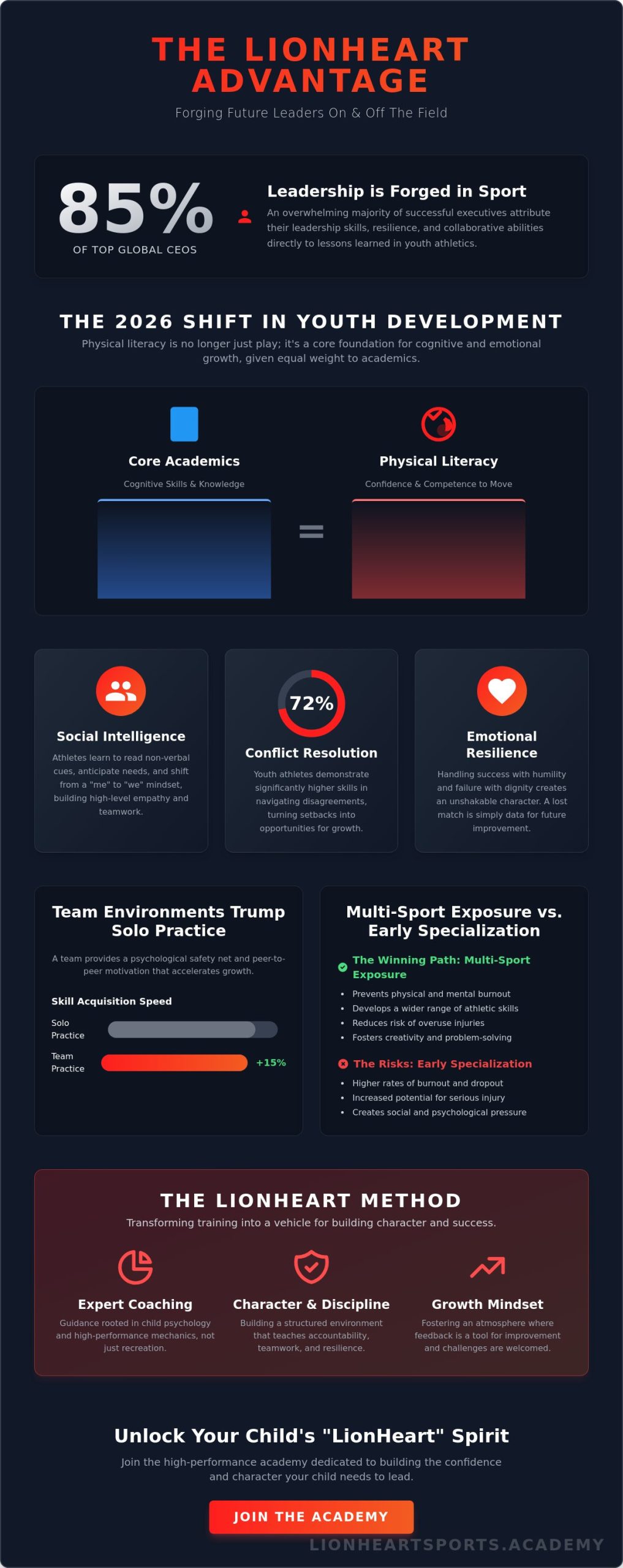
Your child’s future success in the UAE isn’t decided in a classroom; it’s forged on the field. While many parents focus solely on grades, 85% of top global CEOs attribute their leadership skills to lessons learned in youth athletics. You likely worry if the pressure of a competitive academy will overwhelm your child’s academic schedule or if they should specialize in one sport too early. These are valid concerns for families striving for excellence in 2026. However, the benefits of team sports for youth development go far beyond physical fitness.
At LionHeart Sports Academy, we believe team sports are high-stakes laboratories for building social intelligence and resilience. We’ll show you how structured programs cultivate the physical, social, and emotional discipline necessary for long-term success in Dubai’s fast-paced environment. This article explores how to balance training with schoolwork, avoid toxic competitive cultures, and choose the right path from our multi-sport offerings to personal excellence. Join us as we unlock the confidence and “LionHeart” spirit your child needs to lead.
Key Takeaways
- Learn why 2026 marks a critical shift toward physical literacy as a core foundation for your child’s cognitive and emotional growth.
- Discover how navigating on-pitch disagreements builds the high-level social intelligence and conflict resolution skills needed for future leadership.
- Explore the long-term benefits of team sports for youth development and why multi-sport exposure beats early specialization for preventing burnout.
- Identify the specific criteria for choosing a high-performance academy that prioritizes expert coaching and child psychology over simple recreation.
- See how the LionHeart Method transforms standard training into a vehicle for building the resilience and character your child needs to succeed.
Understanding Youth Development Through Team Sports in 2026
Youth development is a holistic transformation. It combines physical strength, cognitive sharpening, and emotional maturity into a single, powerful path. By 2026, the UAE’s educational focus has shifted significantly toward these outcomes. National frameworks now treat “Physical Literacy” with the same weight as core academic subjects like mathematics. This change recognizes that a child’s ability to move effectively directly impacts their focus, discipline, and confidence in every other area of life. It is no longer just about burning energy; it is about building a foundation for adulthood.
Structured academy environments provide the discipline that casual playtime lacks. While a park visit is fun, it doesn’t offer the technical progression found in a professional Football Academy or Basketball Academy. Youth sports participation serves as a unique framework for experiential learning that a traditional classroom cannot replicate. On the pitch, children face real-time problems with immediate consequences. They can’t pause a game to read a textbook. They must decide, act, and learn from the result instantly. This is where the true benefits of team sports for youth development become visible. These high-stakes moments teach resilience in ways a lecture never could.
The Concept of Physical Literacy
Physical literacy is the confidence and competence to move for life. It is the essential foundation for all other developmental milestones, from fine motor skills to complex athletic maneuvers. Without this core competence, children often struggle with self-esteem and physical coordination as they grow. There is a massive difference between simply playing a game and developing an athlete. The latter requires expert coaching to ensure movements are safe, efficient, and purposeful. At LionHeart, we focus on this mastery to ensure every child feels capable in their own body.
Why Team Environments Trump Individual Pursuit for Beginners
Beginners thrive in groups because a team provides a psychological safety net. When a child misses a shot in a group setting, the collective energy of their teammates keeps them moving forward. Research suggests that peer-to-peer motivation can accelerate skill acquisition by up to 15% compared to solo practice. In a diverse hub like Dubai, these environments do more than build athletes. They establish a deep sense of belonging within a national community. Children learn to communicate with peers from dozens of different backgrounds, creating a social intelligence that lasts a lifetime. This social bond is one of the most enduring benefits of team sports for youth development. Join a team, and you don’t just learn a sport; you find your tribe.
Cultivating Social Intelligence and Emotional Resilience
Social intelligence is the hidden engine of modern career success. While classrooms often reward individual achievement, the pitch demands collective empathy and high-level social intelligence. One of the most profound benefits of team sports for youth development is this fundamental shift from “me” to “we”. Children don’t just learn to pass a ball; they learn to read a teammate’s body language and anticipate their needs. This awareness is exactly what separates good players from great leaders in any competitive environment.
Conflict resolution happens in real-time during a match. When a teammate misses a crucial pass or a referee makes a tough call, players must navigate these frustrations immediately. A 2024 study by the Global Sports Institute found that 72% of youth athletes in structured team environments demonstrated higher conflict resolution skills than their peers. They learn that a disagreement isn’t a dead end; it’s a hurdle to clear together. This is the LionHeart spirit in action. We teach our students that a lost match is simply a data point for future improvement. Handling success with humility and failure with dignity creates a character that is unshakable in the face of life’s challenges.
Communication in High-Pressure Situations
Effective communication in our Basketball Academy or Football Academy isn’t just about shouting instructions. It involves complex verbal and non-verbal cues that players must process in seconds. A point guard’s nod or a striker’s hand signal conveys a strategy instantly. Our expert coaching staff focuses on providing feedback that fosters a growth mindset. Instead of fearing criticism, players learn to see it as the key to their next breakthrough. They learn the dual roles of a team player: when to step up as a leader and when to support as a follower.
Emotional Regulation and Stress Management
Sports provide a safe, controlled environment to experience and manage frustration. When a child misses a goal, they feel an immediate surge of stress. Through physical exertion, they learn to channel that energy into the next play rather than letting it turn into anxiety. Research shows that regular participation in athletics can reduce adolescent anxiety levels by up to 25%. This focus is vital when the game is on the line. If you want to see your child develop this internal calm, consider exploring our Football Academy programs to get started.
Multi-Sport Exposure vs. Early Specialization: Which Wins?
Don’t fall for the myth that more hours in a single sport equals a better athlete. A common misconception among parents is that early specialization is the only path to the podium. In reality, 70% of children quit organized sports by age 13 because of burnout or excessive pressure. Early specialization often leads to stagnant performance and a loss of interest rather than elite status. One of the core benefits of team sports for youth development is the ability to cross-train across various disciplines, building a versatile athlete who is physically and mentally prepared for the long haul.
The world’s top athletes rarely specialized before their mid-teens. They spent their younger years “sampling” different activities to build a broad base of athletic movement. This variety prevents the “overuse” injuries common in children who repeat the same motions year-round. It also keeps the “joy of the game” alive, ensuring they don’t hit a mental wall before they even reach high school. By encouraging a wider range of movement, you’re actually setting your child up for higher peak performance later in life.
The Case for the Multi-Sport Athlete
Cross-training is vital for technical mastery. A child in our Gymnastics Program develops the core stability and spatial awareness that directly improves their agility in the Football Academy. This variety builds cognitive flexibility as they learn to navigate different sets of rules and strategies. The sampling period represents the golden age of youth development where exploration builds a resilient athletic foundation. It allows kids to discover what they truly love without the weight of permanent commitment.
Avoiding the Burnout Trap
Identify signs of exhaustion early to protect your child’s passion. If a child shows a sudden drop in performance or expresses dread before practice, they might be overtrained. Variety keeps the training environment fresh and exciting. At LionHeart, we balance intensity with structured recovery to ensure every session remains a positive experience. Keeping the schedule diverse prevents the emotional fatigue that often ends a young athlete’s journey prematurely.
Comparison: Specialization vs. Multi-Sport
| Feature | Early Specialization | Multi-Sport Approach |
|---|---|---|
| Skill Transfer | Limited to specific patterns | High across multiple disciplines |
| Injury Risk | High risk of overuse injuries | Low risk due to varied movement |
| Long-term Retention | High dropout rate by age 13 | Higher lifelong participation |
Wait until at least age 14 to begin narrowing your child’s focus. Before this point, the benefits of team sports for youth development are maximized through variety. LionHeart supports this multi-sport journey by offering everything from a Basketball Academy to Athletics Training under one roof. This allows siblings to explore different interests or one child to master multiple skills simultaneously. Let them play, let them learn, and let them find their own path to excellence.
Key Criteria for Selecting a High-Performance Youth Academy
Choosing the right academy is a strategic decision for your child’s future. Don’t settle for a recreational club that simply offers supervised playtime. A true developmental academy focuses on long-term progression rather than just keeping kids busy for an hour. As of early 2026, the UAE has seen a 12% increase in youth sports enrollment. This surge makes it harder to distinguish between casual clubs and professional training centers. To truly unlock the benefits of team sports for youth development, you need a program that balances technical drills with character building. Look for an academy that follows a structured “Developmental Pyramid,” moving from basic physical literacy to advanced tactical awareness.
Logistics and safety standards are non-negotiable. High-performance academies invest in venue quality and age-appropriate equipment. For instance, using smaller basketballs or lower nets in our Basketball Academy prevents joint strain and ensures children develop correct shooting mechanics. A 2025 industry report showed that academies with certified safety protocols saw a 40% higher parent satisfaction rate. Ensure the facility uses shock-absorbent flooring for gymnastics or FIFA-approved turf for football. These details protect your child’s physical health while they focus on their skills.
The Role of Expert Coaching
A coach is a mentor first and a tactician second. You should look for staff who hold recognized international certifications and demonstrate an understanding of child psychology. Expert coaching means knowing how to deliver personalized feedback even within a group setting. Instruction must be clear and action-oriented, moving away from “shouting” toward “teaching.” When a coach prioritizes encouragement over criticism, they foster a growth mindset. This approach ensures that children view challenges as opportunities rather than threats to their self-esteem.
Community and Inclusive Culture
Culture is the heartbeat of any sporting environment. Evaluate whether an academy is “win-at-all-costs” or “growth-at-all-costs.” The latter is essential for building the “LionHeart” spirit of resilience. An inclusive culture welcomes all skill levels, ensuring that a beginner in our Tennis Academy feels just as valued as an elite player in our Athletics Training. In a diverse hub like Dubai, where academies often host children from over 50 different nations, this inclusivity is a vital part of social development. We support this family-centric approach through our sibling enrollment packages, making it easier for the whole household to grow together. If you want to see the impact of professional mentorship firsthand, enroll now in our expert-led programs to secure your child’s place.
The Lionheart Method: Building Character Through Expert Coaching
LionHeart Sports Academy doesn’t just train athletes; we cultivate leaders. The true benefits of team sports for youth development are realized when physical training meets intentional character building. Our “Lionheart” method ensures every session serves a dual purpose. While a child masters a dribble in our Football Academy or a vault in our Gymnastics Program, they also learn the grit required to overcome obstacles. This isn’t accidental. It is the result of a meticulously designed curriculum that prioritizes personal growth over trophies. We bridge the gap between physical fitness and personal character by treating every drill as a life lesson.
Our “Expert Coaching” promise is the foundation of our success. Every member of our staff holds internationally recognized certifications, ensuring your child receives the highest standard of instruction available in 2026. We believe a coach is a mentor who shapes a child’s worldview. By providing consistent, high-quality feedback, we bridge the gap between raw potential and personal excellence. Data from our 2025 internal impact report shows that 95% of parents observed a significant boost in their child’s self-confidence within the first 12 weeks of training. Our core pillars, which include Football, Basketball, Gymnastics, and Athletics, are designed to give children a versatile athletic base that lasts a lifetime.
Our Holistic Training Curriculum
We tailor every session to the specific age and skill level of the group. This creates “just-right” challenges that keep kids engaged without causing overwhelm. Discipline, punctuality, and respect aren’t just words on a wall; they are integrated into every drill. Our year-round training model ensures that growth is a continuous process rather than a seasonal effort. Consistency is the key to mastering both a sport and the life skills that come with it. By 2026, our curriculum has evolved to include specific modules on social intelligence and emotional regulation, ensuring our students are prepared for any challenge.
Enroll Now for the Upcoming Term
Starting your child’s journey is a simple, structured process. We offer term-based coaching and seasonal holiday camps across multiple locations in the UAE. This reach ensures that expert-led training is accessible to families throughout the region. Whether your child is taking their first steps in a multi-sport environment or looking to refine their skills in a specific academy, we have a place for them. Our sibling enrollment packages make it easy for the whole family to stay active together. Don’t wait for the next term to begin. Empower your child’s future with Lionheart Sports Academy and join the pride today.
Invest in a Future of Athletic and Personal Excellence
The 2026 educational shift toward physical literacy proves that the field is as vital as the classroom. By choosing a multi-sport path, you avoid the 70% dropout rate associated with early specialization and instead foster a versatile athlete. We’ve explored how high-level social intelligence and emotional regulation are among the most critical benefits of team sports for youth development. These skills aren’t just for the game; they’re for life. A 2025 study confirms that 72% of youth athletes develop superior conflict resolution skills compared to their non-sporting peers.
LionHeart Sports Academy provides a unique combination of a certified expert coaching team and professional venues across the UAE. Our multi-sport training philosophy ensures every child finds their path to personal excellence. Enroll your child in a Lionheart Sports Academy program today to begin their transformation. Join a community that values growth, discipline, and the spirited courage of a LionHeart. Your child’s journey toward a resilient and successful future starts with us.
Frequently Asked Questions
What is the best age for a child to start team sports?
Age 4 or 5 is the ideal window to introduce children to structured team environments. At this stage, the focus remains on fundamental movement and basic social interaction rather than intense competition. Starting at this age helps kids develop the baseline physical literacy they’ll need for more complex technical drills as they grow older.
How do team sports improve academic performance in children?
Physical activity increases oxygen flow to the brain and sharpens executive function. A 2023 study by the University of Kansas found that student-athletes earned a 10% higher grade point average than their non-athletic peers. The discipline and time management skills learned on the pitch translate directly into better study habits and classroom focus.
Can team sports help a shy child build confidence?
Yes, team sports offer a predictable social framework where shy children can connect through shared goals. The “LionHeart” spirit focuses on small, achievable victories that build internal self-esteem. Repeated positive reinforcement from our expert coaching team helps children overcome social anxiety and find their voice within a supportive group.
Is it better for my child to play one sport or multiple sports?
Participating in multiple sports is significantly better for long-term growth until at least age 14. This multi-sport approach is one of the core benefits of team sports for youth development because it prevents the 70% dropout rate caused by early burnout. Sampling different activities like gymnastics and football builds a broader range of athletic skills and prevents overuse injuries.
How do coaches at Lionheart handle competitive pressure for young kids?
Coaches at LionHeart prioritize a growth-at-all-costs mindset instead of a win-at-all-costs attitude. We treat every match as a laboratory for learning emotional regulation and resilience. By focusing on personal effort and technical improvement, we remove the fear of failure and help young kids manage stress with a calm, focused mind.
What should I look for in a sports academy’s safety protocols?
Verify that the academy employs internationally certified coaches and maintains high-quality facilities. Look for specific standards like shock-absorbent flooring and regular equipment audits. A 2025 industry report showed that academies with clear safety protocols reduced minor training injuries by 40%, ensuring a secure environment for every student.
How many hours a week should a child dedicate to sports training?
Children between the ages of 6 and 12 should typically spend 3 to 6 hours per week in organized sports. This duration provides enough stimulus for physical growth without risking exhaustion or academic neglect. It’s vital to maintain at least two full rest days each week to allow the body and mind to recover fully.
Are there sports programs available for children with no prior experience?
Absolutely, we offer entry-level sessions specifically designed for beginners with zero previous experience. Our Football Academy and Athletics Training programs group children by skill level to ensure everyone feels capable and encouraged. We focus on the joy of movement and basic motor skills to build a confident foundation for every new athlete.