

What if the hour after the school bell rings became a “Third Space” for elite character development rather than just a way to burn off steam? Since youth sports participation rose to 58% in 2024, the search for high-quality after school sports programs for kids has become a top priority for families. You likely worry about the impact of sedentary habits and the lack of professional coaching in standard school clubs. It’s frustrating to manage a hectic schedule only to find your child isn’t gaining the physical literacy or social confidence they deserve.
We’re here to help you navigate these choices with a focus on long-term athletic potential and personal growth. This guide reveals how the right program can transform your child’s health while providing a clear pathway for their future. We’ll examine the 2026 landscape of youth athletics; including essential safety updates like the new ECG requirements for incoming student-athletes; and provide a roadmap to selecting a program like Lionheart Sports Academy. Discover how to trade logistical stress for a community that values excellence and discipline.
Key Takeaways
- Understand why the “Third Space” environment is vital for building your child’s social identity and character beyond the classroom.
- Learn how to evaluate after school sports programs for kids using five essential criteria; including coach certifications and structured progression frameworks.
- Discover the top high-engagement disciplines for 2026 that offer the best results for physical literacy and long-term growth.
- Get practical strategies for balancing academic demands with athletic training to ensure your child remains focused and energized.
- Explore how expert coaching and a family-oriented atmosphere at Lionheart Sports Academy provide a superior pathway for young athletes.
The Role of After School Sports Programs in Holistic Child Development
Effective after school sports programs for kids are far more than just a way to fill the hours between the final bell and dinner time. These programs provide structured athletic training that targets both physical and mental growth through a methodology known as purposeful practice. Understanding The Role of After School Sports Programs is essential for parents who want to foster long-term health and athletic potential. By participating in organized activities, children move beyond simple recreational play into an environment that values discipline and skill acquisition.
Sociologists often describe this setting as the “Third Space.” It’s the crucial environment between home and school where a child’s social identity begins to take shape. In this space, kids interact with peers and mentors outside of the traditional academic hierarchy. Families prioritize after school sports programs for kids to ensure their children develop social skills in a safe, structured environment. Recent data published in May 2026 shows that U.S. youth sports participation rose to 58% in 2024, nearly matching historical peaks. This growth highlights how much families value these spaces for development.
The benefits extend to the brain as well. There’s a clear link between vigorous physical activity and improved cognitive function. Regular training sessions help children develop better executive function, memory, and focus. With the federal government’s Healthy People 2030 program aiming for 63% participation by the end of the decade, the focus on youth athletics as a tool for cognitive and physical health has never been stronger.
Building Physical Literacy in the Early Years
Physical literacy is the cornerstone of all future athletic achievement. It’s the ability and confidence to move with competence across a wide range of physical activities. At this stage, the focus is on developing fundamental motor skills such as balance, coordination, and agility. These are the building blocks for every sport, from gymnastics to football.
Early multi-sport exposure is vital for reducing injury risk. When children participate in various disciplines, they develop a broader range of muscle groups and movement patterns. This prevents the overuse injuries often seen in early specialization. A 2025 survey found that 20% of parents had to reduce participation due to financial concerns; choosing a multi-sport academy ensures maximum value for every training hour spent by building a versatile athletic foundation.
Character Growth: Strength, Courage, and the Lionheart Spirit
Sports provide a unique laboratory for character development. Children learn to handle failure with resilience and celebrate success with grace. These emotional lessons are just as important as the physical ones. In a team environment, kids develop essential leadership and communication skills that serve them for life. They learn that hard work leads to progress, a mindset that stays with them long after they leave the court.
The Lionheart spirit is about more than just winning; it’s about the courage to try new things and the discipline to stick with them. The structured discipline learned on the field directly translates to improved focus and respect for rules in the classroom.
5 Essential Criteria for Evaluating Quality After School Sports
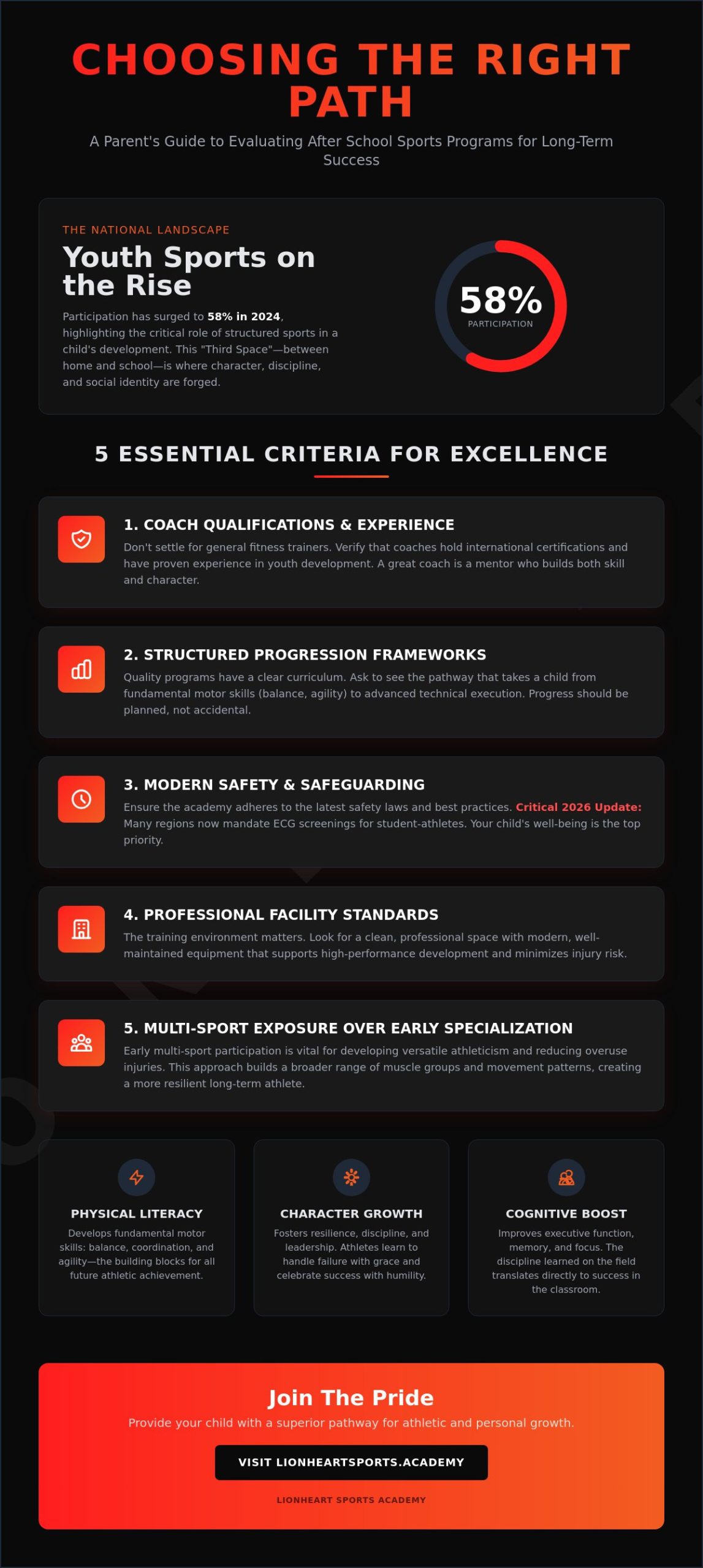
Choosing the right environment for your child’s growth is a significant decision. You aren’t just looking for a place to play; you’re looking for a mentor. High-quality after school sports programs for kids must be evaluated through a lens of professional standards rather than simple convenience. To ensure your child receives the best return on their time and effort, look for programs that meet these five benchmarks:
- Coach Qualifications: Verify that coaches hold international certifications and have specific experience in youth development rather than just general fitness.
- Progression Frameworks: Ask for a clear curriculum that demonstrates how a child moves from basic motor skills to advanced technical execution.
- Safety and Safeguarding: Ensure the academy follows modern safety laws. For example, beginning with the 2026–27 school year, many regions now require mandatory ECG screenings for certain student-athletes to participate.
- Facility Standards: The training environment should be professional, clean, and equipped with modern gear that supports high-performance learning.
- Inclusivity vs. Specialization: The best programs foster a welcoming community while maintaining the competitive rigor needed for athletic growth.
The Importance of Certified Coaching
Expert coaching is non-negotiable. Without it, kids often develop bad habits that lead to plateauing or, worse, preventable injuries. A certified coach acts as a mentor who understands the psychological needs of young athletes. Before you enroll, ask about their specific certifications and how they handle player development. Developing independence and responsibility is a key part of Balancing Academics and Athletics, and elite coaching facilitates this transition by teaching discipline through movement.
Assessing Class Sizes and Individual Attention
Appropriate student-to-coach ratios are critical, especially for technical disciplines like gymnastics or athletics. If a class is too large, your child won’t receive the personalized feedback they need to improve their form. We believe that every child should be seen, challenged, and supported throughout their session. This individual attention allows for “purposeful practice,” turning every hour into a meaningful step toward athletic excellence. If you want to see how these professional standards are applied in real-time, consider the curriculum at Lionheart Sports Academy for your child’s next step.
Top After School Sports Programs for Kids in 2026
The landscape of youth athletics in the UAE is evolving rapidly. In 2026, the best after school sports programs for kids focus on high-engagement disciplines that offer both physical and cognitive rewards. While some parents prefer the individual focus of athletics, others seek the social integration found in team sports. Both paths are valuable, but the real magic happens through multi-sport participation. Research published in December 2025 shows that volleyball registrations rose by over 30% in a single year; this highlights a trend where families move toward versatile athletic training rather than early specialization. Choosing high-quality after school sports programs for kids ensures that your child builds a broad range of skills that protect against burnout and injury.
Families are investing more than ever in their children’s athletic futures. Reports from January 2026 indicate that parents spend an average of $1,016 annually on a child’s primary sport. With this level of investment, the focus must shift from simple supervision to expert coaching. Whether your child is interested in the fast-paced environment of the court or the technical precision of the gymnasium, the goal is to find a program that prioritizes purposeful practice over mere play.
Basketball and Football: The Power of Team Dynamics
Joining a Basketball Academy isn’t just about shooting hoops. It’s an environment that demands split-second decision-making and heightened spatial awareness. Players must track multiple moving parts while maintaining technical form. Similarly, a Football Academy emphasizes technical footwork, cardiovascular stamina, and tactical thinking. These team sports are the ultimate tool for social integration. They teach children how to communicate under pressure and rely on others to achieve a common goal. This social bond is a major reason why youth sports participation hit 58% in 2024. Kids stay for the community as much as the game.
Gymnastics and Athletics: The Foundation of Movement
If you want your child to excel in any sport, they need a solid foundation. A Gymnastics Program is the gold standard for developing core strength, flexibility, and air-awareness. These skills are transferable to almost every other discipline. Meanwhile, Athletics Training focuses on the fundamental mechanics of movement: Agility, Balance, and Coordination. Mastering the basics of running, jumping, and throwing ensures a child is physically literate from a young age. These “base sports” are essential for long-term development. They reduce the risk of injury and provide the explosive power needed for competitive play. Whether your child dreams of the pitch or the court, starting with these foundational movements is the smartest move you can make.
Balancing Academics and Athletics: A Practical Guide for Parents
Managing a high-performance lifestyle requires a disciplined approach to the family calendar. Many parents fear that adding hours of athletic training will detract from academic grades. However, the opposite is often true. Engaging in after school sports programs for kids fosters a level of mental clarity and energy that sedentary habits simply cannot provide. By treating sports as a non-negotiable part of the day, you help your child build a structure that supports their long-term growth. It’s about moving from a mindset of “fitting it in” to one of “building around excellence.”
The myth of early specialization often leads to burnout and academic fatigue. In contrast, multi-sport participation keeps children engaged and mentally fresh. This variety develops cognitive flexibility, which is the ability to switch between different concepts or tasks. This versatility translates directly to the classroom, where students must tackle diverse subjects with the same agility they show on the field. For families, choosing an academy that offers a wide range of disciplines; such as gymnastics, football, and basketball; simplifies logistics while maximizing developmental benefits.
Scheduling for Success
To reduce evening stress, aim to use the immediate after-school window for training. This preserves the later evening for quiet recovery and focused homework. It’s also vital to watch for signs of over-training, such as persistent fatigue or a sudden drop in academic performance. Consistent sports routines improve time-management skills by teaching children how to allocate their hours effectively between the court and the classroom. By sticking to a structured schedule, kids learn that every minute counts, which is a lesson that serves them well into adulthood.
For families with siblings, the logistical burden of multiple locations can be overwhelming. Seeking out a community-oriented academy with “Sibling Enrollment Packages” allows your children to train in different disciplines at the same time and place. This approach transforms the after-school rush into a streamlined, family-centric experience.
The Role of Nutrition and Hydration
Fueling a young athlete starts long before they arrive at the academy. The transition from the classroom to the training ground requires a strategic snack to maintain energy levels. Think of quick, healthy options like a piece of fruit with nut butter or a small portion of Greek yogurt. These provide the necessary carbohydrates and proteins to power through a high-intensity session.
In the UAE climate, hydration is a critical factor for both safety and performance. Young athletes should drink water consistently throughout the school day, not just during their training hour. Recovery is the final piece of the puzzle. Growing bodies typically need 9 to 11 hours of sleep to repair muscle tissue and consolidate the day’s learning. If you’re ready to build a sustainable athletic routine for your family, enroll now in our multi-sport programs to experience expert coaching and organized training.
Join the Pride: Why Lionheart Sports Academy is the Premier Choice
Choosing the right environment for your child means finding a mentor who understands the balance between high-performance training and a welcoming community. Lionheart Sports Academy stands out as the premier destination for after school sports programs for kids because we view athletics as a vehicle for personal development. Our philosophy is built on a foundation of expert coaching and family-centric values. We don’t just teach the rules of the game; we inspire a spirited approach to sports that stays with our students for life. This commitment to excellence is why we’ve become a central community hub in the Dubai market.
Our year-round training model ensures that progress never stops. While many programs take long breaks, we maintain a consistent schedule that builds discipline and muscle memory. During school breaks, our seasonal holiday camps provide an energetic outlet for children to refine their skills and make new friends. This structured approach mirrors the efficiency of a professional training session while remaining accessible to families. We believe that versatility is the key to long-term success. Our multi-sport model allows children to explore different disciplines, which reduces the risk of burnout and helps them discover their true athletic passions.
Expert Coaching Across Multiple Disciplines
Success starts with the right guidance. Our team consists of certified professionals who specialize in Football, Basketball, and Gymnastics. These experts understand the nuances of youth development and tailor every session to the specific skill level of the child. Whether your student is a beginner picking up a ball for the first time or an advanced player seeking competitive rigor, we provide the individual attention they need. You can explore our Basketball Academy programs to see how we build spatial awareness and decision-making skills through purposeful practice. Every drill is designed to challenge the mind as much as the body.
A Supportive Environment for Every Child
The name “Lionheart” is more than just a brand; it’s a metaphor for the strength and courage we aim to instill in every member. We project a personality that is disciplined and energetic yet deeply nurturing. We know that managing a family schedule is a logistical challenge for many parents. To help, we offer Sibling Enrollment Packages that make it easier for the whole family to join the pride. This commitment to inclusivity ensures that every child has a clear pathway for athletic growth in a supportive setting.
Getting started is a seamless process. From your initial inquiry to final enrollment, our team provides a structured and transparent experience. We handle the details of uniforms and scheduling so you can focus on watching your child thrive. It’s time to trade sedentary habits for the joy of movement and the pride of skill development. Enroll your child today and start their athletic journey with a team that values their individual progress and long-term potential.
Build Your Child’s Athletic Legacy Today
Choosing from the many after school sports programs for kids is about more than just filling a time slot. It’s an investment in your child’s resilience, physical literacy, and long-term health. You’ve learned how to identify high-quality coaching and why a multi-sport foundation is essential for preventing injury. By prioritizing structured training, you’re giving your child the tools to excel in the classroom and on the field. They’ll gain the confidence to handle life’s challenges with a spirit of courage and discipline.
At Lionheart Sports Academy, we offer an expert certified coaching team and diverse multi-sport programs designed for holistic development. Our supportive, community-focused environment ensures every student feels seen and challenged. We’re committed to helping your family navigate the transition from school to sports with ease and professionalism. Don’t wait to start this journey. Enroll your child in Lionheart Sports Academy today and watch them develop the strength of a true champion. We look forward to welcoming you into our pride and celebrating every milestone together.
Frequently Asked Questions
What is the best age for a child to start after school sports?
Kids can start as early as age 3 or 4 in foundational movement programs that focus on physical literacy and motor skills rather than competitive play. By age 6, most children are ready for structured after school sports programs for kids like football or gymnastics. With the federal Healthy People 2030 program targeting 63% participation by the end of the decade, starting young helps build a lifelong habit of movement and confidence.
How many days a week should my child participate in sports programs?
Most young athletes thrive with a schedule of 2 to 3 days per week to ensure significant skill development without causing physical exhaustion. For reference, programs like Austin Sports Academy offer tiers for 3, 4, or 5 days, costing between $300 and $350 per month for the 2026-2027 year. Always prioritize the quality of expert coaching over the total quantity of hours spent on the field to avoid burnout.
Is it better to specialize in one sport or try multiple activities?
Multi-sport participation is the recommended path for children to prevent overuse injuries and mental fatigue. Specializing too early can limit a child’s overall athletic potential and increase the risk of specific muscle strain. Research from December 2025 indicates a 30% rise in registrations for versatile sports like volleyball. Trying different activities helps kids discover their true passions while building a broader range of motor skills and coordination.
What safety standards should I look for in a sports academy?
Verify that an academy has certified coaches, clear child protection policies, and first-aid readiness. In May 2026, it was announced that regions like Florida require mandatory $20 ECG screenings for student-athletes beginning in the 2026-27 school year. Ensure the facility uses professional-grade equipment and maintains a safe student-to-coach ratio to provide individual attention and technical supervision during every training session.
How do after school sports programs help with social skills?
Sports act as a “Third Space” where children learn to communicate, lead, and collaborate outside the traditional classroom hierarchy. These environments teach kids how to handle failure with resilience and celebrate success with grace. By interacting with diverse peer groups in after school sports programs for kids, students develop the social confidence needed for adulthood. Team dynamics in basketball or football are particularly effective for fostering long-term friendships and mutual respect.
Do sports programs interfere with my child’s school grades?
Organized sports actually improve academic focus by enhancing executive function and memory. Physical activity increases blood flow to the brain; this helps children stay alert during study sessions. A structured routine teaches kids vital time-management skills that translate to better classroom behavior. When a child has a scheduled practice, they often become more efficient with their homework to ensure they don’t miss their training sessions.
What equipment or uniforms are typically required for enrollment?
Most academies require a specific training kit and sport-appropriate footwear to ensure safety and team cohesion. For example, gymnastics requires form-fitting attire, while football and basketball demand specialized shoes for traction. We provide official Lionheart uniforms upon enrollment to instill a sense of pride and belonging. Parents should also ensure their child has a reusable water bottle to stay hydrated in the UAE climate.
Can my child join a program mid-term or do they need to wait?
Many programs allow mid-term enrollment if there is space available in the specific age group or skill level. Our coaches conduct an initial assessment to place your child in the correct progression framework regardless of when they join the academy. This ensures they aren’t overwhelmed and can catch up with their peers quickly through personalized feedback. It’s always better to start now rather than waiting for a new term to begin.