

What if the secret to your child standing taller and speaking up isn’t found in a textbook, but on a gymnastics mat or a football pitch? Confidence isn’t a personality trait your child is born with; it’s a LionHeart skill forged through the cycle of controlled failure and incremental mastery. While 58% of U.S. children aged 6 to 17 participated in sports teams in 2024, many parents still wonder exactly how sports build confidence in children beyond just physical fitness. You want to see your child trade screen time for social ease and stop the habit of giving up when things get hard.
We understand the worry of seeing a shy child struggle to make friends or lose heart after a tough loss. This guide explains the psychological and physical mechanisms that transform a child’s self-esteem through structured training. You’ll discover how expert coaching and multi-sport programs build resilience and improve emotional regulation. We will explore the shift from “I can’t” to “I will” by looking at the discipline and new safety standards, such as the 2026 ECG requirements for student-athletes, that create a secure environment for personal growth.
Key Takeaways
- Understand the “win-loop” mechanism where small athletic achievements build the self-efficacy your child needs to tackle life’s challenges.
- Learn how “desirable difficulty” helps children overcome the fear of failure and develop a resilient mindset through structured, achievable goals.
- Discover how sports build confidence in children by teaching essential non-verbal social cues and the power of team synergy over individual performance.
- Apply the “Golden Rule” of parenting to support emotional growth at home by prioritizing effort and bravery over final match scores.
- See how the LionHeart Expert Coaching standard develops future leaders by focusing on the spirit of strength and courage in every training session.
The Psychology of Confidence: How Sports Rewire a Child’s Mind
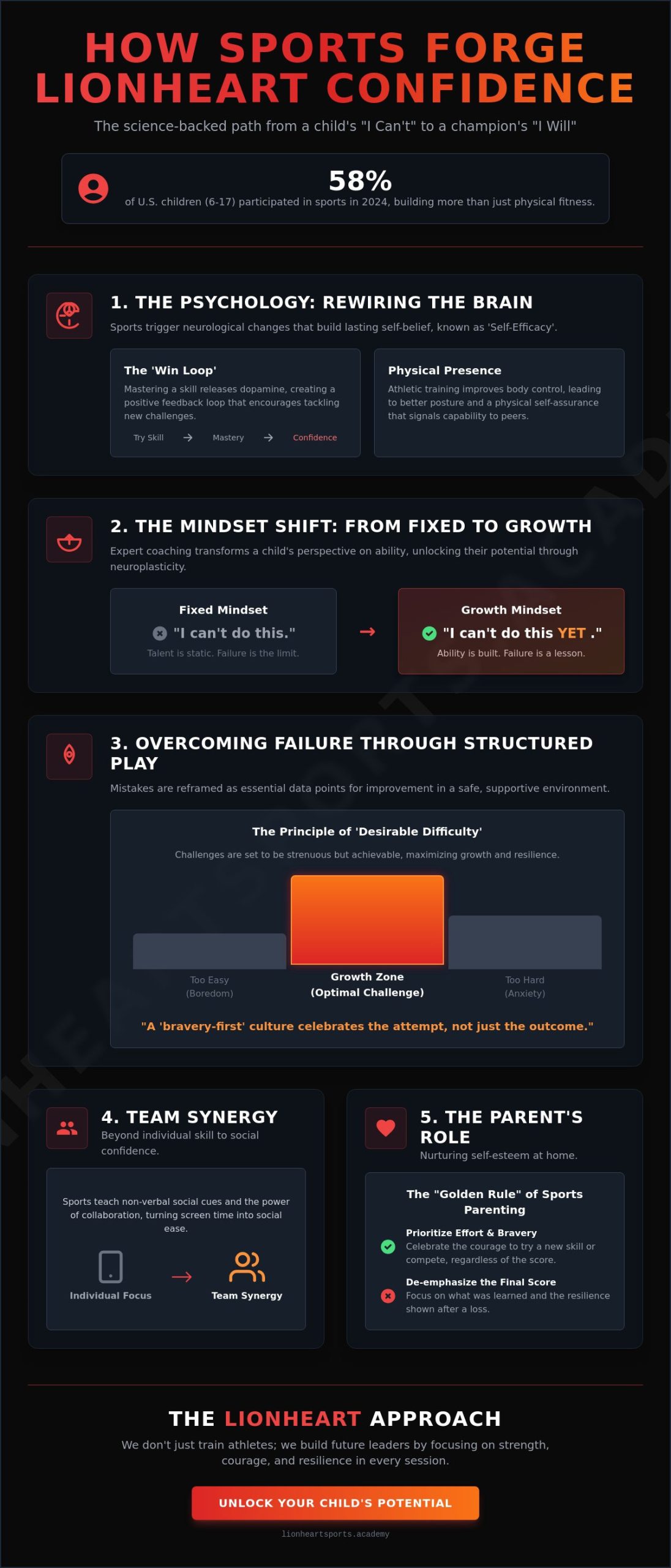
Confidence isn’t a vague feeling of happiness; it’s a measurable psychological state. In the field of Sport psychology, experts define this as “self-efficacy.” This is the specific belief in one’s own ability to succeed in a given task. When we look at how sports build confidence in children, we’re observing a literal rewiring of the brain. When a child masters a chest pass in basketball or a forward roll in gymnastics, their brain releases dopamine. This creates a neurological “win-loop” that encourages them to seek out the next challenge. This chemical reinforcement turns a scary new skill into an exciting opportunity for growth.
A growth mindset in sports is the fundamental understanding that athletic ability is built through consistent effort rather than fixed talent. This shift in perspective is vital for long-term resilience. Beyond the mental benefits, physical competence grants children a sense of “presence” in social spaces. A child who knows how to control their body through athletics training often carries themselves with better posture and occupies space with more certainty. This physical self-assurance is a silent signal to peers that your child is capable and secure.
From Fixed to Growth: The Mindset Shift
Our expert coaches are trained to move children away from the “I can’t do this” trap. By adding the word “yet” to the end of that sentence, we tap into neuroplasticity. The brain’s ability to form new connections is at its peak during childhood. Whether they are learning complex footwork in our football academy or timing a serve in tennis, they’re physically building a more capable brain. These physical growth milestones provide tangible, undeniable proof of progress that a child can see and feel every week.
The Science of ‘Small Wins’ in Athletic Training
We break down every sport into micro-skills to ensure constant progress. A child doesn’t just “play football”; they master the inside-foot pass, then the dribble, then the strike. These small wins accumulate. According to data from 2023, 42% of youth athletes now participate in multiple sports, which allows them to build a massive “reservoir” of confidence. They learn that the discipline used to master a balance beam also applies to a math test or a social introduction. This consistent routine provides a sense of security. It tells the child that through expert coaching and personal effort, any obstacle can be broken down and overcome.
Overcoming the ‘Fear of Failure’ Through Structured Play
Many parents worry that a public mistake on the field will crush their child’s spirit. This fear of failure is often the biggest barrier to entry for hesitant children. However, the Lionheart approach views errors not as setbacks, but as essential data points for improvement. By placing children in environments characterized by “Desirable Difficulty,” we ensure they face challenges that are strenuous yet achievable. This specific balance is a core component of how sports build confidence in children. It teaches them that a missed shot or a fallen hurdle is simply a prompt to adjust their technique, not a reflection of their character.
When we strip away the “shame” of failing, children become more adventurous. They start taking the calculated risks necessary for high level performance. This shift is supported by a peer environment where everyone is working through similar hurdles. If you want to see how our coaches create this supportive atmosphere, explore our multi-sport training programs. We prioritize the act of “trying” as the highest form of success at Lionheart Sports Academy. This focus on effort over immediate perfection allows kids to develop a thicker skin against the setbacks they will inevitably face in life.
Normalizing Mistakes in a Safe Coaching Environment
Our certified coaches are experts in positive redirection. Instead of highlighting what went wrong, we focus on the specific physical adjustment needed for the next attempt. This objective feedback loop removes the emotional sting of a mistake. We foster a “bravery-first” culture where attempting a new skill, like a complex tennis serve or a football volley, is celebrated regardless of the outcome. This safety net allows children to experiment without the fear of social or athletic penalty, making the training ground a laboratory for personal growth.
Building Resilience: The ‘Bounce Back’ Factor
Resilience is the ability to process a “loss” as a temporary state. We teach children that emotional endurance is just as trainable as physical stamina. Consider a child in our gymnastics program struggling to stay on the balance beam. The first few falls might be frustrating, but through consistent expert coaching, that frustration turns into focus. The moment of mastery, when they finally land the move, is a powerful psychological anchor. It proves to the child that their persistence is more powerful than any initial failure. This “bounce back” factor is what prepares them for the pressures of school and future professional life.
Social Confidence: Beyond Individual Achievement to Team Synergy
Social anxiety often stems from the feeling of being watched and judged in isolation. Team sports dismantle this pressure by introducing “Collective Efficacy,” which is the shared belief that a group can succeed through cooperation. This is a primary way how sports build confidence in children. When a child is part of a team, the burden of performance is shared. They aren’t just an individual; they’re a vital part of a cohesive unit. This shift lowers the perceived stakes of personal errors and allows children to focus on their specific role within the group dynamic.
Beyond verbal strategy, sports teach the subtle art of non-verbal communication. On a football pitch or basketball court, children must learn to read body language, maintain eye contact, and anticipate movements without speaking. These are high-level social skills that 58% of U.S. children began practicing through sports in 2024. At Lionheart, we provide a diverse social circle outside of the traditional school setting. This is crucial for children who may feel stuck in specific social roles in the classroom. Here, they can reinvent themselves among new peers who only know them as a teammate and a contributor.
Communication Skills: Finding Their Voice on the Pitch
Expert coaching at Lionheart Sports Academy encourages children to vocalize their intentions during live play. In our Basketball Academy, a player must call for the ball or alert a teammate to an incoming screen. This isn’t just about winning the game; it’s about the confidence to be heard in a crowded or high-pressure space. These environments also force real-time conflict resolution. If two players disagree on a play, they must negotiate a solution quickly to keep the game moving. We often see students progress from quiet observers to leaders who confidently lead a team warm-up or captain a small-sided game during our after school activities.
The Shy Child’s Journey: From Sideline to Center Stage
For the extremely shy child, the Lionheart uniform acts as a psychological “mask.” It provides an immediate sense of belonging and protection, signaling that they’re part of the pride and not an outsider. We often suggest athletics training as a starting point for these children. It allows them to compete against their own personal bests first, which removes the social pressure of a direct opponent. As they gain physical competence, their social anxiety naturally decreases. They eventually move from the sidelines to center stage, carrying the self-assurance they earned through individual effort into the larger team environment.
The Parent-Coach Partnership: Nurturing Self-Esteem at Home
The journey of building a resilient child doesn’t end when the whistle blows. While expert coaching provides the technical foundation, the parent-coach partnership is what cements long-term self-esteem. The “Golden Rule” for parents is simple: prioritize the process over the scoreboard. When parents focus solely on winning, they accidentally teach children that their value is tied to a result they can’t always control. This creates anxiety rather than assurance. Understanding how sports build confidence in children requires a shift in how we celebrate their time on the field.
Effective parents understand how sports build confidence in children by asking the right questions during the car ride home. Instead of asking “Did you win?” or “How many goals did you score?”, try asking “What was the bravest thing you did today?” or “What was the most fun part of the session?” These questions signal that you value their courage and enjoyment more than a trophy. With the average family spending over $1,000 per year on a child’s primary sport as of 2026, it’s tempting to look for a “return on investment” in the form of medals. Real ROI is found in your child’s character development and their ability to stand tall in a group.
- Maintaining steady eye contact with coaches and teammates
- Volunteering to go first during a new or difficult drill
- Speaking up to encourage a teammate after they make a mistake
- Handling a loss or a missed goal without immediate discouragement
- Expressing interest in trying a new sport or skill without being prompted
Constructive Feedback vs. Empty Praise
Empty praise like “You’re a natural” can actually backfire. It makes children afraid to try things they aren’t “naturally” good at because they fear losing that label. Instead, use earned compliments. Say, “I saw how you kept running to find space even when you were tired.” This rewards effort, which is entirely within the child’s control. Model this growth mindset yourself. Share stories of your own professional setbacks and how you learned from them. This normalizes the struggle and shows that even adults are constantly training to improve. Commitment is the foundation of self-respect. Ensure your child understands that showing up for every session is a promise they keep to themselves and their team.
Selecting the Right Program for Your Child’s Personality
Choosing the right environment is critical for a shy or hesitant child. Individual sports like tennis or gymnastics are excellent for children who need to build personal accountability and focus. Team sports like football or basketball are ideal for developing social ease and communication. For children aged 5 to 11, multi-sport exposure is highly recommended. In 2023, 42% of youth athletes participated in multiple sports to build a versatile skill set. This variety prevents burnout and helps them discover where they feel most empowered. Check out our expert coaching programs to find the perfect fit for your child’s unique spirit and energy level.
The Lionheart Approach: Building Future Leaders Through Sport
The Lionheart philosophy is built on three core pillars: Strength, Courage, and Spirit. We don’t just run drills; we cultivate character. While many local programs rely on well-meaning volunteers, our “Expert Coaching” standard ensures that every session is led by a certified professional. These mentors understand the delicate balance between physical demand and child psychology. This professional approach is a primary reason how sports build confidence in children more effectively than unstructured play. We aim to turn athletic progress into a blueprint for life. The discipline learned in our Football Academy or Tennis Academy translates directly to success in future career leadership.
Our long-term vision focuses on the transition from athlete to leader. We believe that a child who can navigate a high-pressure match or master a complex gymnastics routine is better equipped for the challenges of adulthood. By 2026, the youth sports market has grown into a 40-billion-dollar industry, but the focus often remains on professionalization rather than personal growth. Lionheart breaks this mold by prioritizing the individual’s journey. We teach children that their spirit is their greatest asset, and our structured environment provides the safety they need to let that spirit shine.
Our Multi-Sport Philosophy for Holistic Growth
Early specialization puts immense pressure on a child’s developing body and mind. Our multi-sport philosophy encourages kids to explore football, gymnastics, and athletics training simultaneously. This approach prevents burnout and builds “versatile confidence.” By developing a broad physical literacy, children feel capable in any environment. They realize that the coordination gained in gymnastics helps their footwork in basketball. For parents, understanding The Long-Term Benefits of Multi-Sport Participation is essential for making informed decisions. In 2023, 42% of youth athletes participated in multiple sports, and we champion this trend to ensure holistic development over narrow specialization.
Expert Coaching: The Catalyst for Character Development
A coach is often the first non-family mentor a child respects. That’s why we prioritize certified professionals who understand the broader youth sports landscape. For instance, new 2027 regulations in California will require mental health training for coaches, a standard we already embrace in our daily sessions. We view Lionheart Sports Academy as a community hub where every child is seen and valued. This nurturing environment is the catalyst for character development. It ensures your child doesn’t just learn to play; they learn to lead. Join the Academy and start your child’s confidence journey today to see how we build the leaders of tomorrow through the joy of movement.
Equip Your Child for Life’s Greatest Challenges
Confidence isn’t found in a trophy; it’s forged in the consistent effort your child puts in every week. We’ve explored the neurological win-loops of skill mastery and the way team synergy reduces social anxiety. By understanding the mechanics of how sports build confidence in children, you can help transform their fear of failure into a productive path toward personal growth. Whether they’re mastering a balance beam or calling for the ball on the pitch, they’re developing the resilience needed for a successful future.
Our academy provides the ideal landscape for this transformation. Through our Certified Expert Coaches and Multi-Sport Training Philosophy, we ensure your child stays engaged while building a versatile skill set. We’ve built a Family-Centric Community Environment where every student is encouraged to reach their personal best. Don’t wait for self-esteem to happen by chance. Enroll your child in a Lionheart Sports Academy program today and watch them stand taller in every area of life. It’s time to unleash their inner spirit and lead with courage.
Frequently Asked Questions
How long does it take to see a change in a child’s confidence through sports?
Most parents notice a visible shift in their child’s self-assurance after 8 to 12 weeks of regular attendance. This timeframe is essential for how sports build confidence in children because it allows enough time to master micro-skills and experience the neurological win-loop. Consistency is the key to turning a temporary boost into a permanent personality trait. We recommend at least two sessions per week to maintain momentum and social connection.
What if my child is extremely shy and doesn’t want to join a group?
We recommend a gradual entry for hesitant children, often starting with athletics training where the focus is on personal bests rather than direct competition. Our coaches use positive redirection to help shy kids feel safe and seen without being the center of unwanted attention. Once they feel physically capable, the transition to team synergy becomes much easier. The goal is to move them from the sideline to center stage at a pace that feels secure.
Are individual sports better than team sports for building self-esteem?
Neither is superior, but they build different types of resilience. Individual sports like tennis or gymnastics are excellent for building personal accountability and focus. Team sports like basketball develop collective efficacy and essential social cues. In 2023, 42% of youth athletes chose to participate in multiple disciplines to gain both the self-reliance of individual play and the social ease of a team environment. A multi-sport approach offers the most holistic growth.
Can sports help a child who is struggling with academic confidence?
Athletic success often triggers a 15% to 20% improvement in classroom focus and self-discipline. When a child realizes that effort leads to mastery on the football pitch, they apply that same logic to a difficult math problem. This is the growth mindset in action. They stop seeing themselves as “bad at school” and start seeing themselves as students who haven’t mastered the material yet. The discipline of training translates directly to the discipline of studying.
What is the best age for a child to start structured sports coaching?
Structured coaching can begin as early as age 3 for gymnastics or age 5 for team sports like football. The period between ages 5 and 11 is the “golden window” for multi-sport exposure. During these years, children develop 90% of their fundamental movement patterns. Starting early ensures they feel capable in any athletic environment. This physical literacy prevents the social withdrawal often seen in older, less-active children who feel “behind” their peers.
How do I know if a sports academy focuses on character or just winning?
Examine the coaching credentials and the feedback given during drills. A character-focused academy will have mentors who prioritize technical micro-wins over the final scoreboard. This is a key part of how sports build confidence in children through resilience rather than just trophies. Look for programs that follow behavioral health standards, similar to the mandates California is implementing by September 1, 2027. Ask for their philosophy on mistake-making before you enroll.
What should I do if my child wants to quit after the first session?
Implement a “three-session rule” before allowing your child to quit. The first session is often dominated by the fear of the unknown, which can be overwhelming for a young mind. By the third session, the environment becomes familiar and the “desirable difficulty” of the drills starts to feel achievable. This persistence teaches them that the initial anxiety of a new challenge is a temporary hurdle they can overcome with a little courage.
How can I help my child deal with the disappointment of losing a game?
Acknowledge the feeling first, then shift the focus to a specific technical success. Use the car ride home protocol to ask about their effort rather than the final score. Statistics show that 70% of children quit sports by age 13 because of the pressure to win. By focusing on the bravest move they made, you help them build the emotional endurance to process setbacks as temporary data points rather than personal failures.