The fastest way to stall your child’s athletic progress is to force them into a single sport before they turn twelve. While the youth sports market has grown into a 147 billion AED global industry as of 2026, many parents in the UAE still struggle with the fundamental question of how to improve a child’s athletic skills without risking burnout or injury. You want your child to feel confident and energized on the field, but the 46% increase in sports spending since 2019 and the pressure of early specialization can make the path forward feel unclear.
It’s natural to worry if your child lacks coordination or if you’re choosing the right drills for their specific age group. This guide provides a professional framework to develop your child’s physical literacy, mental resilience, and technical prowess through expert-backed strategies. We’ll explore a clear roadmap for long-term development that prioritizes multi-sport variety and the latest safety standards. Discover how to build a well-rounded athlete who possesses the speed, agility, and Lionheart spirit needed to excel in any arena.
Key Takeaways
- Understand why the ages of 6 to 12 are considered the “golden age” for mastering motor skills and building lifelong physical competence.
- Learn how to improve a child’s athletic skills by prioritizing multi-sport participation over early specialization to prevent injuries and promote skill transfer.
- Adopt the “LionHeart” philosophy to build mental resilience, teaching your child to view setbacks as essential data points for growth.
- Implement a simple, 20-minute daily home routine that focuses on consistent movement patterns without the need for expensive equipment.
- Discover how expert coaching identifies technical blind spots and provides the structured curriculum necessary to accelerate your child’s development.
The Foundation of Physical Literacy: Where Every Athlete Starts
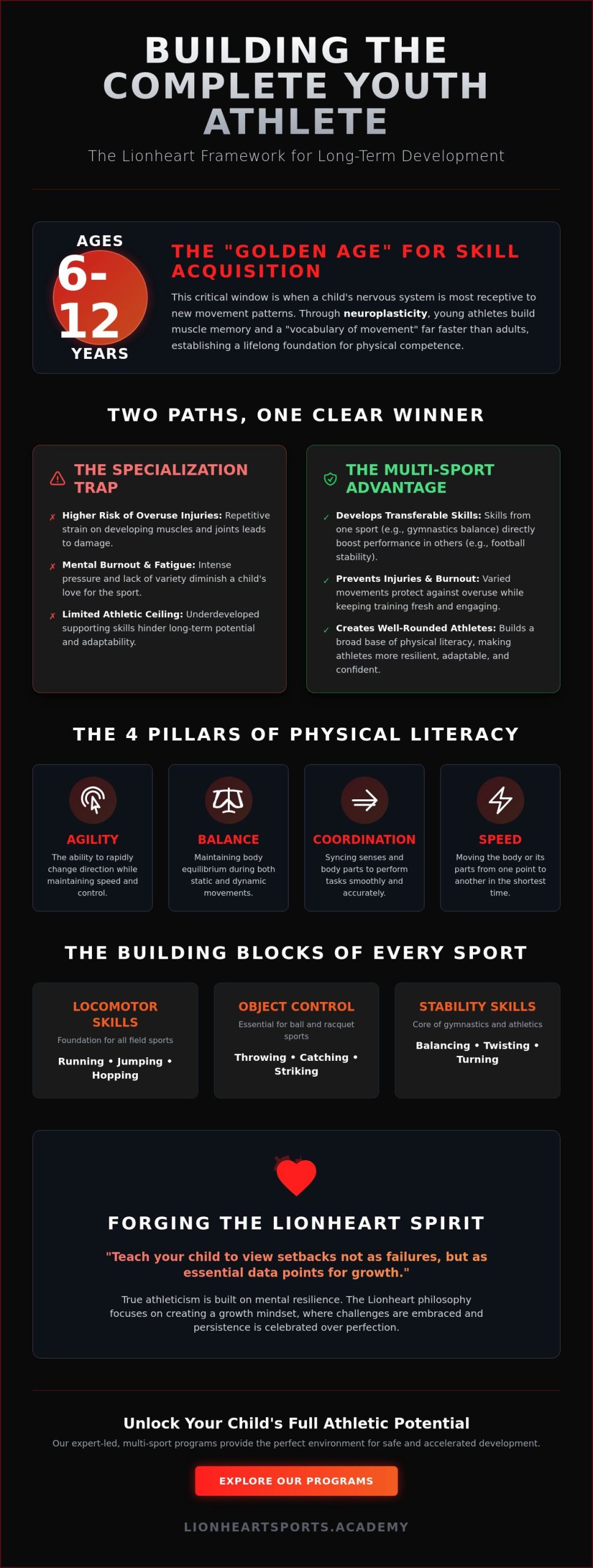
Physical literacy is the bedrock of every great athlete. It’s more than just being “good at sports.” It is the unique combination of motivation, confidence, and the physical competence to stay active for life. Research confirms that the ages of 6 to 12 represent the “golden age” of motor skill acquisition. During this window, a child’s nervous system is exceptionally receptive to new movement patterns. Physical literacy is the vocabulary of movement that allows children to read athletic situations. By focusing on this foundation, you unlock the secret of how to improve a child’s athletic skills before they ever step onto any competitive pitch.
To build a complete athlete, we focus on the four pillars of athleticism, often called the ABCS:
- Agility: The ability to change direction quickly and effectively while maintaining control.
- Balance: Maintaining body position during both static and dynamic movements.
- Coordination: Syncing the senses with body parts to perform tasks accurately and smoothly.
- Speed: Moving the body or parts of the body from point A to point B in the shortest possible time.
Mastering Fundamental Movement Skills (FMS)
Fundamental Movement Skills (FMS) are the building blocks of all complex sports. Locomotor skills like running, jumping, and hopping form the base for every field sport. Object control skills, including throwing, catching, and striking, are essential for our Basketball, Football, and Tennis Academies. Stability skills such as balancing and twisting provide the core strength found in our Gymnastics and Athletics training. Developing these skills early helps parents avoid the dangers of early specialization, which frequently leads to overuse injuries and mental fatigue.
The Role of Neuroplasticity in Youth Sports
A child’s brain is a sponge. Through neuroplasticity, young athletes build muscle memory much faster than adults when they are exposed to varied stimuli. Repetitive, boring drills can actually hinder long-term athletic intelligence by dulling the brain’s engagement. At Lionheart Sports Academy, we keep training play-based to maximize neural engagement. This approach ensures kids stay excited while learning how to improve a child’s athletic skills through active discovery. Join our multi-sport programs to give your child’s brain the variety it craves for elite development.
Why Multi-Sport Participation Beats Early Specialisation
Many parents in the UAE believe that narrowing a child’s focus to a single sport early on is the fastest route to a trophy. This is a common misconception. Early specialization is often a direct path to repetitive strain injuries and mental fatigue. When you are researching how to improve a child’s athletic skills, the most effective strategy is actually to broaden their horizons. A diverse athletic background creates a more resilient, adaptable, and confident athlete.
The National Youth Sports Strategy emphasizes that multi-sport participation is vital for long-term health and success. Different sports challenge different energy systems and muscle groups. For instance, football builds incredible aerobic endurance, while basketball requires explosive anaerobic power and verticality. This variety prevents the specialization trap where certain muscles are overworked while others remain underdeveloped. If you want a well-rounded athlete, our multi-sport training programs offer the perfect environment for this holistic growth.
Transferable Skills: The Cross-Training Advantage
Athletic transfer is the secret weapon of elite performers. Skills learned in one arena often solve problems in another. Gymnastics is the mother of all sports because it builds unparalleled core strength and spatial awareness. A child who understands how to control their body in the air will be a better jumper in basketball and a more balanced runner in athletics. Basketball training sharpens hand-eye coordination and explosive power, which are essential for a goalkeeper in football or a server in tennis. Our Athletics program focuses on optimized running mechanics, ensuring every step a child takes on any field is efficient and powerful.
Avoiding the Specialisation Trap
Identifying the signs of burnout early can save a child’s sporting career. Look for a sudden decrease in performance or a visible lack of enthusiasm for practice. Repetitive strain in single-sport youth athletes often leads to injuries that could have been avoided with a more varied schedule. Consider this comparison of development paths:
- Multi-Sport Variety: Lower risk of overuse injuries, higher mental engagement, and a broader movement library.
- Single-Sport Focus: Increased risk of burnout, repetitive stress on developing joints, and limited adaptability to new physical challenges.
By exposing your child to different team dynamics and coaching styles, they learn how to improve a child’s athletic skills while also becoming socially adaptable. This versatility is exactly what modern scouts and expert coaches look for in high-potential athletes.
Building the “Lionheart” Spirit: Developing Mental Resilience
Mental resilience is the psychological engine that powers physical performance. At Lionheart Sports Academy, we believe that true athleticism requires more than just speed; it demands the courage to face challenges head-on. This “Lionheart” spirit focuses on discipline and a spirited approach to every obstacle encountered on the court or field. While physical drills are essential, mental toughness is a skill that must be coached, not just expected from young participants. It is the bridge between having raw talent and becoming a truly impactful athlete.
We teach our athletes to frame “failure” as a necessary data point in the learning process. This perspective aligns with the American Development Model (ADM), which prioritizes long-term psychological health over immediate results. By championing a growth mindset, we encourage children to value their persistence over innate talent. This shift in focus is a vital component of how to improve a child’s athletic skills, as it keeps them motivated during the inevitable plateaus of training. When effort is the metric of success, children feel empowered to take the creative risks necessary for elite development.
Managing Performance Anxiety and Pressure
High-pressure moments in youth sports can often lead to performance anxiety. We teach children techniques to stay in the “zone,” such as controlled breathing and positive visualization. Parents also play a critical role, particularly during the “car ride home.” By focusing on effort rather than the final score, you help your child build a “quiet certainty” in their abilities. This support system is crucial for maintaining confidence during competitive play and ensuring they remain eager to return to the next session.
Character Building Through Discipline and Teamwork
Sports serve as a classroom for life, teaching essential lessons in time management and social intelligence. A “Lionheart” leader is defined by their ability to encourage teammates and show respect to officials, even when the game is not going their way. These interactions develop empathy and help children navigate complex team dynamics. Learning to lead and follow effectively is another dimension of how to improve a child’s athletic skills while preparing them for success far beyond the sports arena.
A Step-by-Step Home Routine to Boost Athleticism
Consistency beats intensity every time. You don’t need a high-end facility or expensive equipment to start seeing results. Developing a daily habit at home is the most effective way to understand how to improve a child’s athletic skills. A simple 20-minute window can bridge the gap between weekly academy sessions and elite performance. Focus on quality movement rather than exhaustion. This approach ensures your child builds a resilient body while keeping the “Lionheart” spirit alive through manageable, daily wins.
The 20-Minute Agility and Coordination Circuit
Perform this circuit four times a week to see significant gains in reactive speed and body control. It’s designed to be done in a living room or a small garden space.
- Step 1: Dynamic Warm-up (5 Minutes): Use “animal walks” to prep the nervous system. Bear crawls and crab walks engage the entire core and improve shoulder stability. Add arm circles to increase blood flow to the joints.
- Step 2: Coordination Drills (5 Minutes): Use balloon taps or wall balls. Keeping a balloon in the air using only feet or alternating hands sharpens hand-eye and foot-eye coordination. These drills are essential for mastering object control in basketball and tennis.
- Step 3: Agility Shadowing (5 Minutes): Stand opposite your child and move side-to-side or forward-and-back. Have them mimic your movements exactly. This “shadowing” builds reactive speed and mimics the unpredictable nature of a football match.
- Step 4: Cool Down and Flexibility (5 Minutes): Focus on holding basic stretches for 20 to 30 seconds. This is a critical time for injury prevention and improving the long-term range of motion required for gymnastics.
The Recovery Pillar: Sleep and Nutrition
Skill consolidation happens while your child rests. The National Sleep Foundation recommends that school-aged children receive 9 to 11 hours of sleep per night. This is the “secret weapon” for athletic improvement. During deep sleep, the brain processes the motor patterns learned during the day, turning new drills into permanent muscle memory. Without adequate rest, even the best training program will fail to produce results.
Nutrition serves as the fuel for the Lionheart. In the warm UAE climate, where summer temperatures often exceed 40°C, hydration is non-negotiable. Ensure your child drinks water consistently throughout the day, not just during practice. Simple dietary wins include pre-training snacks like local dates or bananas for quick energy. Post-training, opt for Greek yogurt or a small handful of nuts to support muscle repair. To take these foundations to the next level, enroll in our professional Athletics Training to receive expert coaching tailored to your child’s growth.
The Role of Professional Coaching in Accelerating Progress
While home routines build essential habits, professional coaching provides the technical precision required for high level performance. Parents are the best motivators, but certified coaches identify the specific technical blind spots that often go unnoticed. A child might have an inefficient foot strike in athletics or a slight misalignment in their basketball shooting form. Correcting these flaws early is a fundamental part of how to improve a child’s athletic skills before they become ingrained habits. Expert eyes ensure that every movement contributes to the child’s overall development and safety.
A professional academy environment offers a structured curriculum that random play simply cannot replicate. While the average registration fee for a youth sports organization is approximately 725 د.إ per athlete, the value at Lionheart Sports Academy lies in our systematic approach to growth. We foster healthy competition and peer learning, which allows children to push their limits in a controlled, supportive setting. Our academy stands as a national leader in holistic development, ensuring every child receives a balanced athletic education that evolves with their changing needs.
Why Certified Coaching Matters
Safety is the primary driver of our coaching philosophy. Our staff ensures that every child maintains correct form to prevent long term joint and muscle issues. We understand the physiological stages of development, which allows us to tailor training intensity to the specific age group. Beyond technical instruction, our coaches act as mentors who embody the Lionheart spirit. They build lasting bonds with students, providing the encouragement needed to master complex skills in our Gymnastics or Tennis Academies.
Finding the Right Academy Environment
Look for programs that maintain low coach to student ratios to ensure your child receives individual attention. An inclusive, welcoming atmosphere is essential for children to feel safe while attempting new, difficult maneuvers. Having diverse programs like our Football, Basketball, and Athletics training under one roof provides the variety necessary for physical literacy without extra travel. Join Lionheart Sports Academy to start your child’s journey today!
Build the Foundation for Future Success
The journey to athletic excellence is a marathon, not a sprint. By integrating physical literacy with mental resilience, you give your child the tools to thrive in any sporting environment. This guide has shown that understanding how to improve a child’s athletic skills requires a balance of varied play, consistent home routines, and the expert eye of a certified coach. These elements work together to create a confident, well-rounded individual who views challenges as opportunities for growth.
Lionheart Sports Academy remains dedicated to these principles through our Multi-Sport Training Programs and commitment to National Excellence Standards. Our Certified Expert Coaches provide the mentorship and technical guidance necessary to turn potential into performance. We invite you to become part of a community that values progress, versatility, and the joy of movement across the UAE.
Empower your child with the Lionheart spirit-Enroll in our Academy today!
Your child’s path to physical excellence starts with the right foundation. Let’s build that future together and inspire a lifetime of health and confidence.
Frequently Asked Questions
How can I tell if my child is ready for competitive sports?
A child is ready for competitive sports when they show a consistent interest in organized play and can follow basic multi-step instructions. Most developmental experts suggest waiting until age 6 or 7 for formal competition. At this stage, their physical literacy is developed enough to handle the structure of an academy environment. Ensure they have the emotional maturity to handle the social dynamics of a team before enrolling.
Is it better for a child to focus on one sport or multiple sports?
Multiple sports are significantly better for long-term development and injury prevention. Research from 2024 participation reports suggests that multi-sport athletes have lower burnout rates and higher overall engagement. Focusing on variety is a key part of how to improve a child’s athletic skills. It prevents the 15% decline in participation often seen when children feel forced into a single discipline too early.
What are the best exercises to improve a child’s speed and agility?
The best exercises focus on reactive movement and coordination rather than just raw power. Incorporate animal walks like bear crawls for core stability and balloon taps for hand-eye coordination. Shadowing drills, where a child mimics a partner’s movements, are excellent for developing reactive speed. These drills require zero equipment and can be performed at home in just 20 minutes a day to see results.
How much should a child practice their sport each week?
A common guideline is to limit organized sports practice to one hour per week for every year of the child’s age. For example, a 10-year-old should not exceed 10 hours of structured training weekly. This balance ensures they have enough time for recovery and unstructured play. Over-training is a leading cause of the 46% increase in youth sports spending being diverted toward injury rehabilitation since 2019.
What should I do if my child wants to quit a sport?
If your child wants to quit, start by identifying the root cause through a calm conversation. It might be performance anxiety or a lack of connection with the current team dynamic. Encourage them to finish the current season to teach commitment and the value of finishing what they start. If the lack of interest persists, consider switching to a different discipline in our multi-sport academy to find a better fit.
How can I help my child build confidence after a loss?
Help your child build confidence by shifting the focus from the scoreboard to their personal effort. Treat every loss as a data point for future growth rather than a final verdict on their talent. Ask them to name one thing they did well and one thing they want to practice more next time. This approach fosters the LionHeart spirit and builds the mental resilience needed for long-term success.
Can gymnastics really help my child perform better in football or basketball?
Gymnastics provides a massive advantage in football and basketball by building superior core strength and spatial awareness. A child who learns body control in our Gymnastics Program will have better vertical power on the basketball court and more stability during football tackles. It’s often called the mother of all sports because the skills learned on the mat transfer to every other athletic arena.
What is the “Golden Age” for learning new athletic skills?
The “Golden Age” for learning new athletic skills is between 6 and 12 years old. During this six-year window, the brain’s neuroplasticity is at its peak for motor skill acquisition. Training during this period is the most effective way to understand how to improve a child’s athletic skills. It sets the foundation for all future physical achievements and helps bridge the participation gap seen in higher-income households.