
Stop telling your child to “hit” the ball. Most parents think dribbling is a test of strength, but the secret to professional control is actually “petting” the ball with the finger pads to absorb its energy. It’s tough to watch your child’s excitement fade when the ball rolls away or bounces off their toes. You want them to gain confidence and burn off that extra energy, but knowing how to teach a child to dribble a basketball without the technical frustration is a challenge every sports parent faces.
At Lionheart Sports Academy, we believe every child can master the court with the right mentorship. We’ve built a comprehensive roadmap to turn those palm slaps into elite fingertip control through expert-backed drills and progressions. You’ll learn how to keep practice fun for short attention spans while establishing a foundation for team play. From selecting the correct 14-ounce Size 4 ball for your 5-year-old to mastering the “triple threat” stance, this guide gives you the tools to become your child’s favorite coach. Let’s transform those backyard sessions into a source of pride and bonding.
Key Takeaways
- Learn why the palm is the enemy of control and how to use finger pads to develop a professional “feel” for the ball.
- Discover a proven 3-step progression on how to teach a child to dribble a basketball that eliminates the fear of losing control and builds rhythm.
- Master the “Walking the Dog” technique to help your child maintain ball position while moving and looking ahead instead of at their feet.
- Identify and fix the “Double Dribble” trap and high-bounce habits before they become difficult-to-break technical flaws.
- Understand how expert coaching and peer-to-peer learning at a basketball academy can accelerate your child’s skill acquisition and confidence.
Mastering Hand Placement: The ‘Finger Pads’ Secret
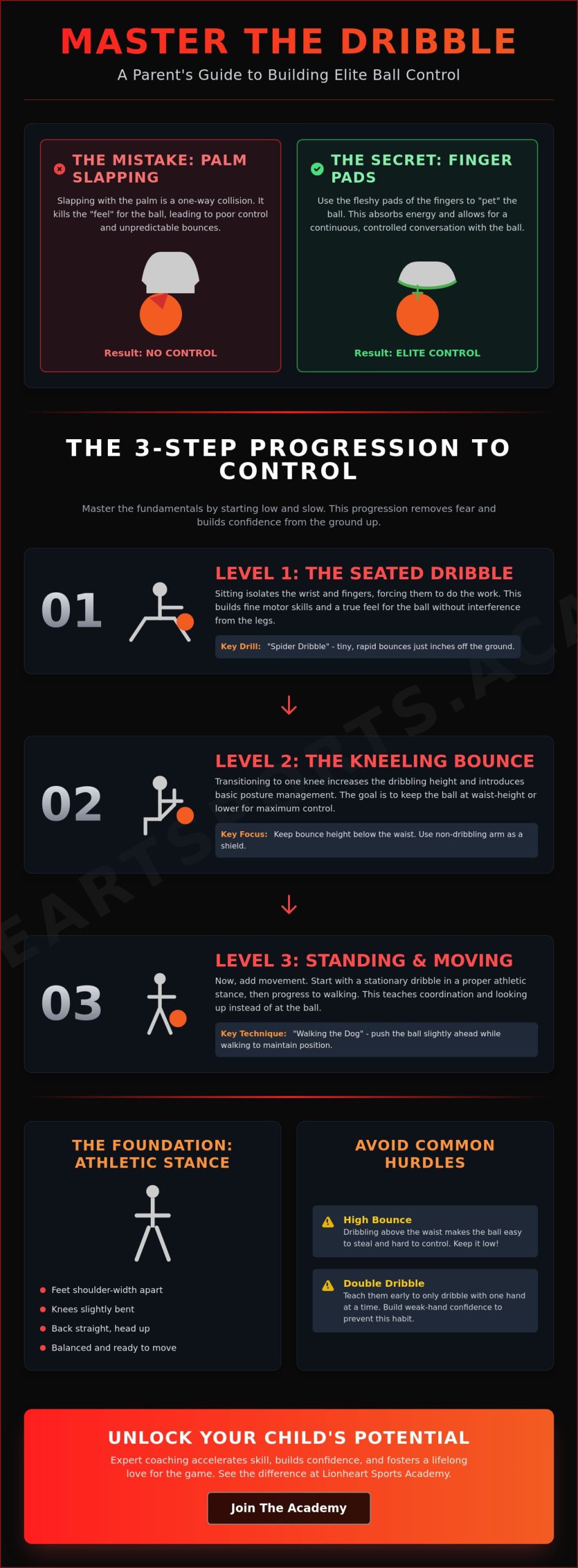
The palm is the enemy of a fluid dribble. When a child slaps the ball with their palm, they lose the ability to “feel” the leather and react to its movement. Dribbling is a fundamental skill in basketball that requires finesse rather than brute force. To start, teach your child to use their finger pads. These are the fleshy parts of the fingers just below the tips. Unlike the hard fingertips, the pads act like shock absorbers. They catch the ball as it rises and push it back down with precision. If you want to know how to teach a child to dribble a basketball effectively, you must start with this tactile connection.
At Lionheart Sports Academy, we use the “Bird in the Hand” metaphor to explain this touch. Imagine holding a small bird; if you’re too stiff, you’ve crushed it; if you’re too loose, it flies away. This balance of strength and softness is essential for control. We also identify the index and middle fingers as the “Power Fingers.” These two fingers provide the final push that dictates the ball’s direction. By focusing on these specific points of contact, a child moves from chaotic slapping to intentional ball manipulation.
The ‘No-Bounce’ Sensory Drills
Before the ball ever hits the floor, use sensory drills to build grip strength and confidence. These exercises remove the “fear of losing the ball” and allow the child to focus entirely on their hands. Start with these three movements:
- Ball Slaps: Have the child hold the ball and slap it hard with alternating hands. This “wakes up” the nerve endings in the finger pads and strengthens the grip.
- Fingertip Taps: Keep the ball at chest height and tap it quickly back and forth between the hands. It should look like a piano player moving across the keys with fast, light touches.
- Around the World: Pass the ball in circles around the waist and then the knees. This builds a 360-degree awareness of the ball’s weight and texture.
Finding the ‘Pocket’ of the Ball
Consistency comes from hitting the same spot every time. Teach kids to visualize the “pocket” or the exact center of the ball. If they push the side of the ball, it will fly away; if they push the top, it returns straight to their hand. This requires a disciplined body position to maintain the right angle. The Athletic Stance is a balanced position with knees slightly bent, feet shoulder-width apart, and the back straight to allow for maximum agility and power. Establishing this posture early ensures that as they learn how to teach a child to dribble a basketball with movement, they have the stability to stay in control.
The 3-Step Progression: From Slaps to Controlled Dribbles
Don’t rush your child into running drills immediately. Most young players feel overwhelmed by the speed of a bouncing ball, which leads to the common “slapping” habit. To fix this, we start low. Removing the physical distance between the hand and the floor reduces the fear of losing control. When you are learning how to teach a child to dribble a basketball, remember the “Push, Don’t Slap” mantra. A slap is a one-way collision; a push is a continuous conversation with the ball. This rhythmic movement ensures the ball returns to the hand at a predictable speed and height.
Control is also about what the other hand is doing. Teach children to use their “non-dribbling” arm as a shield or an arm bar. This protects the ball from defenders and helps with balance. According to the Jr. NBA, keeping the ball at waist-height or lower is the golden rule for youth players. Anything higher becomes difficult to coordinate and easier for opponents to steal. If your child thrives in a structured environment where these habits are reinforced daily, our Basketball Academy provides the perfect setting for these progressions at Lionheart Sports Academy.
Level 1: The Seated Dribble
Have your child sit directly on the floor with their legs spread. This position isolates the wrist and fingers, forcing them to do all the work without the legs providing extra power. Start with the “Spider Dribble,” which involves making tiny, rapid bounces just an inch or two off the ground. It’s a fantastic way to develop fine motor skills. Insist on switching hands every 30 seconds. Building “weak hand” confidence from day one prevents the lopsided skill development that plagues many older players.
Level 2: The Kneeling and Standing Bounce
Once the seated dribble feels natural, move to a kneeling position on one knee. This increases the distance the ball travels and introduces height management. The goal is to keep the ball bouncing consistently to the side of the knee, never in front where it might hit a foot. Finally, move to a full standing position. Revisit the “Athletic Stance” from our previous section; knees bent and back straight. Introduce the “V-Dribble,” where the child pushes the ball in a V-shape from side to side in front of their body. This adds lateral movement and prepares them for the next stage: dribbling while walking.
Dribbling on the Go: Adding Movement and Coordination
Stationary practice is comfortable, but basketball is a game of constant motion. The biggest hurdle for young players is coordinating their feet with their hands without tripping. To solve this, we use the “Walking the Dog” metaphor. Imagine the ball is a dog on a leash; you must keep it at your side, not directly in front of you. This side-of-body positioning is a core component of any 7-step guide to dribbling because it prevents the ball from hitting the player’s feet. At LionHeart Sports Academy, we’ve found that this simple mental image helps kids maintain a consistent path while they move.
When you’re figuring out how to teach a child to dribble a basketball while moving, timing is everything. Most children will try to run immediately, which leads to a loss of control. We focus on a strict one-to-one ratio: one bounce for every step. Once they master the rhythm of a walk, we transition them to a “power trot.” This is a controlled, purposeful jog that keeps the ball at waist height while increasing the physical demand. It’s the bridge between basic practice and real game speed.
The Walking Progression
Start with simple straight lines on a driveway or court. Encourage your child to walk slowly, focusing entirely on syncing their steps with the bounce of the ball. Use these drills to add variety:
- Follow the Leader: Walk ahead of your child and change directions or speeds suddenly. They must mirror your movements while keeping their dribble alive.
- Household Obstacles: Place shoes or water bottles in a zigzag pattern. Have the child “carve” around these items, which teaches them how to lean into turns without stopping.
- Stop and Go: Blow a whistle or shout “Red Light” to practice immediate control. This builds the ability to kill the ball’s momentum instantly.
Eyes Up: Developing Court Awareness
Looking at the ball is a safety net that we must remove early. If a player is staring at the floor, they can’t see open teammates or approaching defenders. We use the “Chin Up” cue to fix this. If the chin is up, the eyes naturally move away from the ball. Dribbling with the eyes up rewires the brain to trust tactile feedback from the finger pads rather than relying on visual confirmation.
Try the “Number Game” to make this fun. While your child dribbles, stand a few feet away and hold up different numbers of fingers. The child must shout out the number as soon as they see it. This forces them to use their peripheral vision, which is a basketball player’s greatest tool for navigating a crowded court. Mastery here turns a mechanical skill into an instinctive athletic response.
Overcoming Common Hurdles: Mistakes and Fun Games
Mistakes aren’t failures; they’re feedback. When you’re learning how to teach a child to dribble a basketball, you’ll likely encounter the “Double Dribble” trap. Children often use two hands because they feel they lack the strength to control the ball with one. To break this reflex, encourage them to keep their “off-hand” active as a shield, which naturally prevents the second hand from touching the ball. Another common issue is the “High Bounce.” Kids feel safer when the ball is high, but this makes it easy for opponents to steal. We teach the “Rib Rule”: never let the ball bounce higher than your ribcage for maximum protection.
A runaway ball often leads to a violation as the child panics and grabs it with both hands. Instead, teach the “Stop and Pop” recovery. If the ball gets away, the child should sprint to catch up, get into their athletic stance, and use their finger pads to regain control. Frustration will happen. When it does, shift the focus from the result to the effort. If you want to see these corrections in action under the guidance of professional mentors, enroll your child in our Basketball Academy today to build their confidence through expert-led sessions.
High-Energy Dribbling Games
Games are the best way to keep short attention spans engaged while reinforcing technical skills. These three activities are staples in our curriculum:
- Red Light, Green Light: This is the best way to teach sudden stops. On “Red Light,” the child must stop and hold their dribble low. On “Green Light,” they explode forward with a power trot.
- Dribble Tag: This game forces the child to protect their ball using their shield arm while trying to tag a parent or sibling. It builds incredible spatial awareness and defensive instincts.
- The Obstacle Course: Use household items like shoes or water bottles to create a zigzag path. Time your child as they navigate the course to add a healthy sense of competition and urgency.
Correcting the ‘Slap’ Reflex
The “Quiet Dribble” challenge is a favorite at LionHeart. Challenge your child to make their dribble as silent as possible. If you hear a loud “thwack,” they’re using their palm. If it’s a soft “thud,” they’ve mastered the finger pads. We also use wrist-flick drills to focus on the “wave” motion of the hand. The power should always come from the wrist and fingers, not the shoulder. Finally, help them identify when to use a high dribble for speed in the open court versus a low dribble when navigating through “traffic” or obstacles.
Expert Coaching: Why a Basketball Academy Makes the Difference
Home practice is the vital foundation for any young player, but there’s a limit to what a backyard session can achieve. Learning how to teach a child to dribble a basketball is a journey that eventually requires a broader stage and a community of peers. In an academy setting, peer-to-peer learning becomes a powerful catalyst for skill acquisition. When children see their teammates successfully navigating a crossover or a speed dribble, it sparks a natural desire to keep pace. This social dynamic turns repetitive practice into an engaging, shared experience that builds resilience and healthy competitive drive.
Professional feedback is the essential safeguard against long-term technical flaws. While a parent might focus on whether the ball stays in motion, an expert coach watches the flick of the wrist, the balance of the stance, and the subtle placement of the feet. We catch and correct “bad habits” before they become permanent muscle memory. At LionHeart Sports Academy, we call this the “Spirit of the Lion” approach. It isn’t just about the mechanics of the game; it’s about instilling the courage to try new moves, the discipline to repeat them, and the ambition to excel on and off the court.
The Academy Advantage
We provide more than just a space to play. Our students gain access to professional-grade equipment and premium indoor courts across the UAE, ensuring that training continues in a comfortable, high-standard environment year-round. Our certified coaches specialize in age-appropriate pedagogy, which means the way we teach a five-year-old is fundamentally different from how we train a teenager. The LionHeart way focuses on building character alongside technical skills, teaching kids that the discipline they learn during a dribbling drill is the same discipline they need for school and personal growth.
Join the Pride
Transitioning from individual practice to a team-based environment is a major milestone. It’s the moment where a child learns to communicate, strategize, and support their teammates. We offer various enrollment options to suit your family’s schedule, including term-based coaching and high-energy seasonal holiday camps. Our sibling packages and multi-sport training opportunities ensure that every member of the family has a path to athletic excellence. Ready to see your child gain professional-grade control? Register your child for a trial basketball session at Lionheart Sports Academy and start their journey toward becoming a confident, skilled athlete today.
Ignite Your Child’s Potential on the Court
Turning a hesitant beginner into a confident ball-handler requires patience and a solid technical foundation. By focusing on finger pad control and moving through a structured progression from seated drills to active movement, you’ve already given your child a significant advantage. These steps ensure they develop the “feel” for the ball that separates casual players from true athletes. Mastering how to teach a child to dribble a basketball is a rewarding journey that builds coordination, focus, and discipline.
While home sessions are a great start, the right environment can accelerate their growth. LionHeart Sports Academy provides certified professional coaches and nationwide training locations across the UAE to help your child thrive. We focus on holistic development, ensuring every student builds both technical skill and strong character. Enroll Your Child in the Lionheart Basketball Academy Today to join a community that values excellence and empowerment. Let’s work together to turn those backyard sessions into game-day success. Your child’s journey to greatness starts with a single bounce.
Frequently Asked Questions
What is the best age for a child to start learning to dribble?
Children can typically begin learning basic basketball skills as early as age 5 or 6. At this stage, their gross motor skills and hand-eye coordination are developed enough to handle a youth-sized ball. Early introduction focuses on familiarity and movement rather than perfect technique. Starting at this age builds a lifelong comfort with the sport and establishes a foundation for physical excellence.
What size basketball should my child use for practice?
For children aged 5 to 8, the official standard is a Size 4 basketball, which has a 25.5-inch circumference and weighs 14 ounces. Once they reach ages 9 to 11, transition them to a Size 5 ball with a 27.5-inch circumference. Using the correct weight is crucial because a ball that’s too heavy can lead to poor shooting mechanics and bad habits that are difficult to correct later.
How can I teach my child to dribble with their non-dominant hand?
Integrate the “weak hand” into every drill from the very first day of practice. Force the non-dominant hand to do equal work during stationary drills like fingertip taps or seated bounces. When learning how to teach a child to dribble a basketball, preventing a dominant-hand reliance early on ensures they become a versatile player who can navigate the court in any direction.
How long should a child’s basketball practice session last?
Keep practice sessions between 15 and 30 minutes for younger children to match their natural attention spans. Focused, high-energy bursts are much more effective than long, grueling sessions that lead to frustration. Quality is always more important than quantity. If your child remains engaged, you can extend the time with a fun game to keep the experience positive and rewarding.
My child keeps double dribbling; how do I fix this habit?
Fix the double dribble habit by teaching your child to use their “off-hand” as a protective shield or arm bar. This keeps the second hand occupied and prevents the “two-hand reflex” when they feel they are losing control. Use verbal cues during drills to remind them that once the ball is caught with two hands, the dribble is over and they must pass or shoot.
Do we need a professional basketball court to practice dribbling?
You don’t need a professional court to master essential ball-handling skills. Any flat, hard surface like a driveway, a quiet sidewalk, or even a tiled garage floor works perfectly for daily drills. The goal is to find a consistent bounce that allows the child to focus on their hand placement and rhythm. Practice can happen anywhere there is a bit of space and a solid floor.
How can I make basketball practice more fun for a 5-year-old?
Gamification is the most effective way to keep a 5-year-old engaged and motivated. Turn every drill into a challenge, such as the “Quiet Dribble” or “Red Light, Green Light” games mentioned earlier. When you understand how to teach a child to dribble a basketball through play, they’ll view every session as a fun bonding activity rather than a disciplined chore, which helps burn off extra energy.
What are the first three basketball skills a child should learn?
The first three essential skills are the “Athletic Stance,” controlled dribbling, and basic chest passing. Mastery of the athletic stance provides the physical foundation for all basketball movement. Dribbling establishes their individual connection with the ball’s rhythm and texture. Finally, passing introduces the concept of teamwork and coordination with others, which is vital for transitioning into a team-based academy environment.