Your 30s aren’t the end of your athletic journey; they’re the beginning of your most disciplined and efficient era of physical mastery. While learning a new sport in your 30s might feel daunting, it’s actually the best time to build lasting athletic skill. It’s natural to feel hesitant when stepping onto a court for the first time in years. You might worry about slower recovery times or the 4.4 million sports-related injuries reported in 2024. Since beginners face a higher risk of moderate injury than advanced players, the fear of getting hurt can feel like a genuine barrier to your fitness goals.
At Lionheart Sports Academy, we believe this decade is your “Technical Era” where discipline and resources make you a more efficient learner than a teenager. This guide reveals how to master a new skill safely with expert coaching. We’ll explore how professional guidance helps you avoid the strains that account for 30% of sports injuries and the knee issues that make up 20% of cases. You’ll discover how to join an adult-friendly community that values growth, versatility, and physical excellence across the UAE market.
Key Takeaways
- Discover why your mature brain and financial independence make learning a new sport in your 30s more effective than starting as a child.
- Learn to protect your body by prioritizing dynamic stretching and recovery techniques tailored to the unique needs of an adult athlete.
- Use our 3-step framework to select a sport that matches your impact tolerance and social aspirations, whether you prefer team camaraderie or individual mastery.
- Skip the trial-and-error of self-teaching and accelerate your progress through expert coaching and structured athletic curriculums.
- Understand how to transition from a beginner to an intermediate level without hitting plateaus by investing in professional guidance from day one.
Why Your 30s are the Golden Era for Learning a New Sport
Forget the outdated myth that you’ve passed your athletic prime. Modern sports science proves that 30 is effectively the new 20 for those who train with intention. While a teenager might have raw speed, you possess the cognitive infrastructure to outpace them in technical execution. Learning a new sport in your 30s isn’t just a weekend hobby; it’s a strategic investment in your physical and mental longevity.
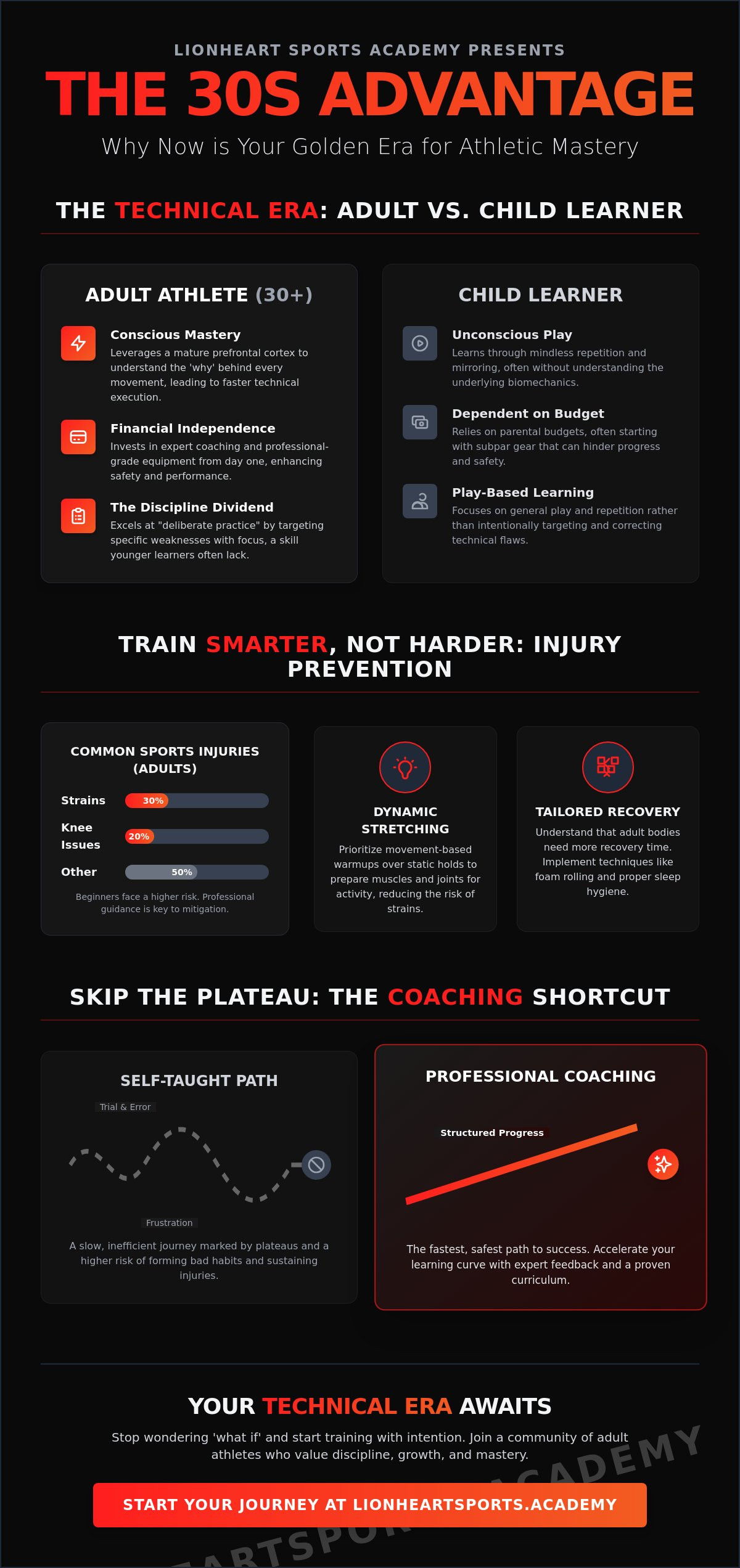
Your brain remains remarkably plastic well into adulthood. Unlike children who often play through mindless repetition, your mature prefrontal cortex allows you to visualize complex movements and understand the biomechanics behind every drill. This is what we call the “Discipline Dividend.” Adults follow expert coaching instructions with a level of precision that younger learners often lack. You aren’t just moving your body; you’re engineering a higher level of performance through conscious effort. Join a structured program and you’ll see that your ability to process feedback is your greatest competitive advantage.
The Science of Adult Skill Acquisition
Adults excel at “deliberate practice.” This is a focused method of training that intentionally targets specific technical weaknesses rather than simply repeating comfortable patterns. By understanding the stages of skill acquisition, you can navigate the transition from a novice to a competent performer with surprising speed. Your adult cognitive focus allows you to isolate variables and accelerate technical mastery in a single session. You also benefit from existing muscle memory. Even if you haven’t stepped onto a Football pitch or Basketball court in a decade, your nervous system retains foundational patterns of balance, coordination, and spatial awareness that act as a springboard for new skills.
Beyond Fitness: The Mental Edge
Sports provide a mental escape that a treadmill simply cannot offer. Entering a “flow state” during a competitive Tennis match or a structured Athletics session provides immediate relief from professional stress. Choosing to be a beginner again in your 30s builds a unique type of resilience. You learn to embrace the discomfort of a steep learning curve within a professional environment, which translates directly to increased confidence in your career. In the UAE, sports academies serve as essential social hubs. Learning a new sport in your 30s connects you with a community of ambitious, like-minded individuals. You’ll find that the camaraderie found on the field often leads to stronger social bonds and professional networking opportunities than any corporate event.
Adult Athletes vs. Child Learners: Understanding the Difference
Training as an adult is fundamentally different from childhood play. While a child learns through “unconscious play,” adults require a clear technical framework to succeed. When learning a new sport in your 30s, you shouldn’t settle for the “just follow along” approach used in youth programs. You need to understand the “Why” behind every drill to make it stick. Children might mirror a coach’s movement without thought, but your brain thrives on logic and biomechanical context. This need for understanding isn’t a hurdle; it’s your shortcut to rapid improvement.
One major advantage you have now is financial capability. Unlike a teenager relying on a parent’s budget, you can invest in expert coaching and professional-grade gear from day one. High-quality equipment isn’t just about status. It’s about safety and feedback. For example, a high-end Tennis racket or properly fitted Football boots can prevent the injuries discussed earlier. This ability to skip the “budget” phase allows you to focus entirely on performance metrics rather than fighting against subpar tools. You aren’t just playing; you’re performing.
The Advantage of Intentionality
Adults use logic to deconstruct sports movements. Where a child might just swing a racket, you analyze the angle of the wrist and the shift in weight. This transition from “unconscious play” to “conscious mastery” is a superpower. You can leverage your life experience to manage competitive pressure in a way a child cannot. The benefits of learning a new sport extend into your professional life, as the same mental grit required for a tough training session fuels your career resilience. You’re learning to solve physical problems with the same maturity you use in the boardroom.
Managing the Ego on the Field
Stepping into an academy as a beginner can trigger imposter syndrome. It’s vital to remember that being “bad” at a new skill is actually a sign of high character. It shows you’re willing to step outside your comfort zone. Shift your focus from aesthetic goals, like weight loss, to skill-based achievements. Celebrate hitting your first three-pointer or mastering a backhand. These milestones provide more sustainable motivation than a number on a scale. If you’re ready to start this journey with professional support, enroll in our adult-friendly coaching programs designed specifically for mature learners who value excellence over ego.
Physical Longevity: Protecting Your Body in Your 30s
In your 30s, your cardiovascular engine is often at its peak, but your musculoskeletal chassis requires more deliberate maintenance. Learning a new sport in your 30s means acknowledging that your joints and tendons have a different mileage than they did at 18. Verified data shows that sprains and strains account for 30% of all sports injuries, while knee injuries, including ACL tears, make up 20%. To stay on the field, you must transition from a play-only mindset to a preparation-first philosophy. This starts with your pre-session routine. Static stretching before a match is outdated and potentially harmful. You need dynamic stretching, such as leg swings and torso twists, to prime your nervous system and increase blood flow to cold tissues.
Strength and conditioning are the silent partners of any successful adult athlete. You cannot simply play your way into fitness; you must be fit to play. Building a base of functional strength protects your chassis from the high-impact forces found in Basketball or Football. It’s also vital to listen to Yellow Lights. These are the minor niggles or persistent tightness that suggest an injury is brewing. Ignoring these signals is a mistake. Professional athletes know that addressing a yellow light today prevents a red light and a long recovery period tomorrow. Respect your body’s signals to ensure your athletic journey lasts for decades, not weeks.
The Adult Athlete’s Recovery Toolkit
Recovery is where the actual progress happens. For adult learners, sleep, hydration, and protein synthesis are the three pillars of longevity. Aim for seven to nine hours of quality sleep to allow for hormone regulation and tissue repair. Active recovery, such as a light walk or a low-intensity swim, is superior to total rest for 30-somethings because it promotes circulation and nutrient delivery to recovering muscles without adding mechanical stress. Incorporate foam rolling and mobility work as a standard part of your sport rather than an afterthought. These tools help maintain the range of motion required for technical mastery and prevent the stiffness that leads to poor form.
Injury Prevention Through Expert Technique
Poor form is the primary driver of overuse injuries in older beginners. When you lack proper biomechanics, your body compensates by overworking smaller, more vulnerable muscles. This is where the value of a coach’s eye becomes undeniable. An expert coach can correct a faulty Tennis swing or a heavy-footed running gait before it leads to chronic pain. Always remember that power should only be applied after a pattern is mastered. Mastering the basic movement ensures your body is structurally ready to handle the force of high-intensity play. Start slow, get the technique right, and the results will follow naturally.
How to Choose the Right Sport: A 3-Step Framework
Selecting an activity shouldn’t be a random decision based on what is trending on social media. You need a logical approach that balances your physical capacity with your professional lifestyle. Learning a new sport in your 30s is a long-term commitment to your personal development. Unlike your younger years when you might have jumped into any game, this stage of life requires a strategic selection process. Use this three-step framework to find a discipline that aligns with your current goals and physical baseline.
Step 1: Impact and Intensity Audit
Analyze your current joint health and cardiovascular fitness before committing to a program. High-impact sports like our Basketball Academy or Football Academy involve significant vertical loading and rapid changes of direction. If you have a history of minor joint issues, these require a more cautious ramp-up. Conversely, technical sports like our Tennis Academy or Gymnastics Program allow for a more controlled environment where you can focus on biomechanics. Match the intensity to your reality. If you’ve been sedentary for the last 5 years, starting with a high-intensity Athletics Training program requires a structured progression to avoid the common beginner injuries discussed earlier.
Step 2: Social and Competitive Alignment
Determine whether you need the accountability of a team or the specific focus of 1-on-1 coaching. Team-based sports provide built-in camaraderie and social pressure that keeps you consistent. If you miss a session, your teammates notice. If you prefer deep technical mastery and rapid skill acquisition, our Sports Personal Training offers the individual attention required to move through the stages of skill acquisition quickly. Group coaching at LionHeart strikes a perfect balance. It offers the social integration of a community while maintaining the discipline of a professional athletic curriculum. You’ll find a community that matches your ambition level and supports your growth.
Finally, evaluate your schedule and past experiences. UAE professionals often navigate demanding corporate calendars. Term-based consistency is excellent for building habits, but private coaching offers the flexibility needed for a high-pressure career. Look back at your 20s for “Transferable Skills.” If you have a background in endurance activities, you’ll likely find the transition to our Football Academy easier. If you possess high levels of flexibility from previous yoga or dance practice, you already have a foundation for our Gymnastics Program. Use your history to fuel your future success.
Ready to discover your new athletic passion with professional guidance? Enroll now at LionHeart Sports Academy and take the first step toward mastering a new skill today.
Why Professional Coaching is the Shortcut to Success
Many adults attempt to bypass formal training by relying on “YouTube University.” While digital tutorials offer plenty of information, they lack the critical element of observation required for safety. Learning a new sport in your 30s without professional oversight is a significant risk. You cannot see your own biomechanical errors from the perspective of a camera. A screen won’t tell you if your weight distribution is off or if your grip is causing unnecessary strain on your tendons. Without a coach, you risk joining the 4.4 million individuals treated for sports injuries annually by reinforcing improper movement patterns.
Structured curriculums are the antidote to the “plateau effect” that plagues most adult learners. Most self-taught beginners hit a wall within the first three months because they lack a logical progression. At LionHeart, we move you through specific phases of development that align with your physical capacity. This organized approach ensures you aren’t just getting tired; you’re getting better. You also gain access to professional-grade facilities in the UAE that provide the high-standard surfaces and equipment necessary to protect your body while you train.
The Value of Real-Time Feedback
Instant corrections prevent you from “baking in” bad habits that become nearly impossible to break once they’re part of your muscle memory. There is a massive psychological boost when an expert validates your progress with technical data and encouragement. Professional coaching reduces the learning curve by 50% compared to unguided practice. Instead of spending weeks guessing why your serve is hitting the net or why your sprint start feels sluggish, you get an immediate solution. This efficiency is vital for busy professionals who need to maximize every minute spent on the court or field.
Joining a Legacy of Excellence
Training at LionHeart Sports Academy means immersing yourself in an environment that values the “LionHeart” spirit. This isn’t just about physical activity; it’s about personal development, strength, and courage. Our academy structures provide the consistency and accountability that adults often lack when training alone. When you have a scheduled session with a mentor and a supportive community of athletes, your commitment levels skyrocket. This disciplined atmosphere helps you master difficult skills while building a new social circle in a world-class training environment.
Ready to start? Explore our Adult Coaching programs today!
Start Your Athletic Transformation Today
Your 30s represent a powerful opportunity to redefine your physical limits and build a body that lasts. By leveraging your mature discipline and understanding the biomechanical context behind every movement, you can achieve technical mastery faster than you ever did as a teenager. Learning a new sport in your 30s is a strategic move for your longevity, provided you prioritize expert guidance and structured recovery to protect your joints and tendons. At LionHeart Sports Academy, we provide the high-standard professional environment you need to succeed without the risk of plateauing.
Our certified expert coaches design specialized programs for all skill levels, ensuring you move from novice to competent athlete with total confidence. Whether you join our Football Academy or master the court in our Tennis Academy, you’ll benefit from real-time feedback in a supportive community of like-minded professionals. We offer structured environments that turn your ambition into measurable excellence. Don’t let hesitation hold you back from the pride of mastering a difficult new skill as an adult. Discover your inner athlete-Join Lionheart Sports Academy today! Step onto the field and embrace the spirit of excellence that defines our academy.
Frequently Asked Questions
Is 30 too old to start gymnastics or basketball?
No, 30 is not too old to begin these disciplines. Our Basketball Academy and Gymnastics Program are specifically designed to accommodate mature learners who want to build strength and coordination from scratch. While you might not be aiming for the Olympics, you can achieve a high level of technical competency and physical excellence. Most adult beginners find that their increased focus and discipline help them master foundational movements faster than younger students.
How many times a week should I train when starting a new sport?
Start with two to three sessions per week to allow your body to adapt to new physical demands. This frequency provides enough repetition for muscle memory without overloading your central nervous system. Recovery is vital in your 30s, as beginners are more prone to the sprains and strains that account for 30% of sports injuries. As your conditioning improves, you can gradually increase to four sessions while maintaining a strict active recovery protocol.
Will I be the only adult in a beginner class?
You certainly won’t be alone. There is a massive trend toward social and community-based fitness in the UAE, with thousands of professionals learning a new sport in your 30s to expand their social circles. Our classes at LionHeart are filled with like-minded adults who share your ambition and drive. We foster a welcoming environment where the pride of skill development is celebrated by the entire group, regardless of your starting point or previous experience.
How do I prevent joint pain when starting a high-impact sport in my 30s?
Prevent joint pain by prioritizing dynamic warm-ups and investing in strength training to support your chassis. High-impact activities like Basketball or Football place stress on the knees, which account for 20% of all sports injuries according to 2024 data. Using expert coaching to correct your biomechanics ensures you aren’t placing unnecessary force on your joints. Always wear high-quality, sport-specific footwear to provide the cushioning and stability required for professional academy surfaces.
How long does it take to become ‘good’ at a new sport as an adult?
Most adults reach a level of functional competency within six to twelve months of consistent, guided training. While mastery is a lifelong pursuit, the learning a new sport in your 30s process is accelerated by your ability to follow structured curriculums. By training twice weekly with professional guidance, you’ll likely move from a complete novice to a confident intermediate player within one year. Your progress depends heavily on your commitment to deliberate practice and technical feedback.
Should I do personal training or group classes as a beginner?
Start with Sports Personal Training if you want to accelerate your technical mastery and ensure safe movement patterns. Individual sessions allow a coach to focus entirely on your specific biomechanics and personal fitness goals. However, group classes are excellent for social integration and learning how to apply skills in a dynamic environment. Many of our members choose a hybrid approach, using one-on-one sessions to refine technique while attending group classes for camaraderie and match play.
What gear do I need to start training at an academy?
You need high-quality, sport-specific footwear and breathable athletic apparel to ensure safety and comfort. For our Football Academy, this means boots suitable for the specific pitch surface, while our Tennis Academy requires non-marking court shoes. Don’t overlook the importance of a professional-grade water bottle and a towel for hydration and hygiene. Investing in the right gear from day one isn’t just about performance; it’s a critical step in preventing the injuries that sideline beginners.
Can learning a new sport help with career burnout?
Yes, engaging in a new sport is a powerful method for combating career burnout and professional stress. The intense focus required to learn a skill like a backhand or a tactical play triggers a “flow state” that provides a total mental break from corporate demands. By stepping onto the field, you build resilience and a sense of achievement that isn’t tied to your professional identity. This mental reset often leads to increased productivity and a more balanced perspective on your career.