

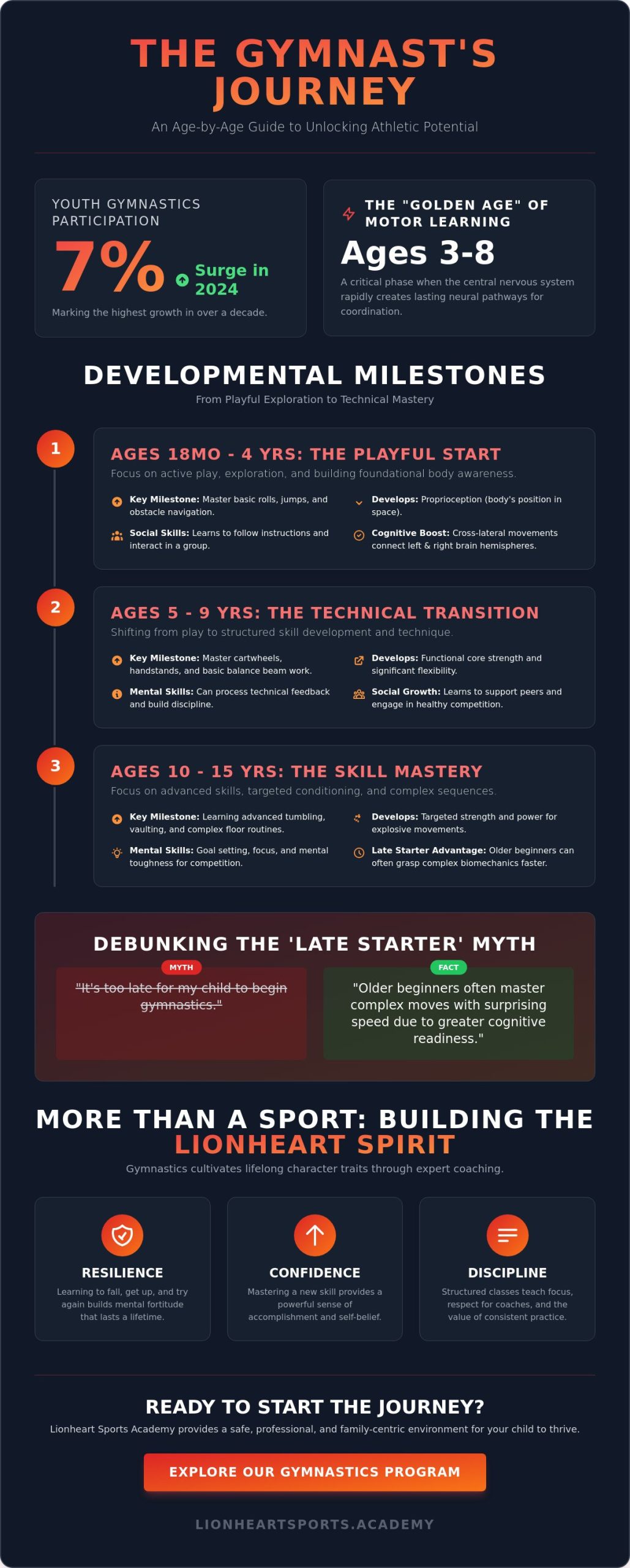
Did you know that youth gymnastics participation surged by 7% in 2024, marking the highest growth in over a decade? This massive interest has many parents across the UAE asking: what age should a child start gymnastics to maximize these benefits without risking early burnout? You want to see your child develop coordination and strength, but the fear of injury or the confusion between recreational and competitive tracks can feel overwhelming. It’s natural to worry that starting too late means they’ll fall behind their peers. At Lionheart Sports Academy, we believe gymnastics is the mother of all sports and a vital foundation for any young athlete.
This guide provides a clear roadmap for every developmental stage. You’ll discover how to choose a program that builds confidence and elite physical literacy. We’ll explore the transition to digital rulebooks in 2026 and how expert coaching ensures your child thrives at every age. Whether your goal is recreational fun or a competitive path, you’ll find the answers needed to start your child’s journey with confidence and pride.
Key Takeaways
- Pinpoint the foundational window between ages 2 and 6 to understand what age should a child start gymnastics for peak physical literacy.
- Identify key physical and mental milestones to track your child’s progress from toddler play to structured skill development.
- Debunk the myth that it’s ever too late to begin and see why older beginners often master complex moves with surprising speed.
- Understand how gymnastics fosters the ‘LionHeart’ spirit, building lifelong resilience and confidence through expert coaching.
- Learn what to look for in a UAE sports academy to ensure a safe, professional, and family-centric training environment.
The Best Age to Start Gymnastics: Is There a Perfect Window?
Every child follows a unique developmental path, yet sports science points to a specific timeframe where the body and brain are most receptive to new physical patterns. While you might wonder what age should a child start gymnastics, the ideal window usually opens between 2 and 6 years old. During these years, children are like sponges for physical literacy. This period isn’t just about learning flips; it’s about building the foundational movement patterns that support every other sport your child might try later in life.
The “golden age” of motor learning occurs between 3 and 8 years old, a critical phase when the central nervous system develops most rapidly and creates lasting neural pathways for coordination.
Starting early doesn’t mean jumping straight into the complex Olympic apparatus found in the history of artistic gymnastics. It begins with fundamental body control. At age 2, a child’s balance is still developing. By age 5, their coordination improves significantly, allowing for more structured movements. In the UAE, where families value high-quality after-school activities, finding a program that respects these physiological stages is essential for long-term success.
Early Childhood (Ages 2-5): Building the Foundation
Classes for this age group prioritize “active play” over rigid technical drills. Our expert coaching focuses on developing proprioception, which is the body’s ability to perceive its own position in space. Children learn to roll, jump, and hang. These movements build the core strength required for later years. Beyond the physical, these sessions teach toddlers how to follow multi-step instructions and interact within a group. It’s the first step in creating a disciplined, LionHeart spirit. For parents in Dubai, these early sessions are perfect for burning energy while building social confidence.
School Age (Ages 6+): Transitioning to Technique
Once a child reaches age 6, their cognitive readiness shifts. They can now process technical corrections and understand the logic behind a specific movement. This is when we introduce more intensive work on flexibility, strength, and specific apparatus like the beam or bars. The focus moves from general physical literacy to skill-based progression. At this stage, the what age should a child start gymnastics question becomes less about “too early” and more about “readiness for challenge.” Six-year-olds possess the attention span to master multi-step sequences, turning recreational fun into tangible athletic achievement through our focused gymnastics program.
Age-by-Age Breakdown of Gymnastics Milestones
Understanding the specific progression of the sport helps clarify what age should a child start gymnastics for your family’s unique needs. At Lionheart Sports Academy, we don’t just teach flips; we cultivate a mindset of courage. Our expert coaching staff adapts every lesson to match the physiological and psychological readiness of the student. This ensures that every child, regardless of their starting point, experiences the profound Benefits of Gymnastics in a structured environment.
Toddlers and Preschoolers (18 Months – 4 Years)
At this stage, the focus is on active play and exploration. Milestones include mastering crawling through tunnels, climbing over obstacles, jumping with two feet, and performing basic forward rolls. We prioritize cross-lateral movements, which require the left and right sides of the brain to communicate. This is vital for early cognitive development and physical literacy. Safety is our primary concern. We use specialized soft mats and age-appropriate equipment to encourage toddlers to take their first brave steps in a secure space.
Primary School Beginners (5 – 9 Years)
This is the era of foundational technique. Children begin to master cartwheels, handstands, and basic balance on the low beam. The physical focus shifts toward building functional core strength and flexibility. Mentally, this age group starts to develop discipline and the ability to accept technical feedback from their coaches. It’s also a social milestone. Students learn to support their peers and engage in healthy competition. If you want to see your child build this unique resilience, you can explore our gymnastics program to find the right fit for their current level.
Pre-Teens and Teens (10 – 15 Years)
Older beginners and intermediate students focus on advanced tumbling, vaulting, and complex floor sequences. At this age, athletes benefit from targeted conditioning to support their growing bodies and prevent injuries. One major advantage for teens is their superior body control, which often leads to rapid skill acquisition compared to younger children. This stage emphasizes personal goal setting and the grit required to master difficult maneuvers. It’s where the Lionheart spirit truly shines, as students learn that persistence is the key to athletic excellence in any discipline.
The ‘Late Starter’ Myth: Is It Ever Too Late to Begin?
Parents often feel anxious about the athletic timeline. They worry that if their child didn’t start tumbling as a toddler, they’ve missed their chance for success. This is simply not true. While many sources cite USA Gymnastics guidelines regarding early development, those standards often focus on the narrow path to elite, world-class competition. For the majority of families in Dubai, the goal is “Recreational Excellence.” This means building a strong, agile body and a resilient mind without the crushing pressure of an Olympic track. We see teens join our academy every day and find immediate joy in mastering a new skill.
In fact, older children often progress up to two times faster than their younger counterparts. A 10-year-old beginner brings a level of body awareness that a preschooler simply hasn’t developed yet. They can listen to a coach’s technical correction, visualize the change, and apply it to their next attempt immediately. Don’t let the calendar stop your child’s progress. What age should a child start gymnastics depends more on their personal interest and drive than a specific birthday or milestone.
Why Older Beginners Have a Cognitive Edge
Older beginners grasp the “why” behind every movement. They understand how the center of gravity affects a balance beam routine or how momentum fuels a vault. This cognitive maturity translates to higher intrinsic motivation. They aren’t just following a teacher; they are chasing their own personal goals. This focus allows our expert coaching staff to move through technical progressions much more efficiently. Communication is a two-way street at this age. This leads to safer, more rapid skill acquisition and a deeper sense of pride in their athletic journey.
Gymnastics as a Supplement for Other Sports
Gymnastics is the ultimate cross-training tool for any young athlete in the UAE. If your child is already active in a football academy or plays competitive basketball, gymnastics provides the explosive power and air awareness they need to excel. A 12-year-old starting now will develop better landing techniques, significantly reducing their injury risk in other high-impact sports. They learn how to fall safely and recover quickly. This protects them on the pitch, the court, and in daily life. Join a session today to see how these foundational skills transform your child’s overall fitness and confidence.
How Gymnastics Builds Character and ‘Lionheart’ Spirit
While the physical gains are undeniable, the psychological transformation is the true reward of this sport. When parents in the UAE ask what age should a child start gymnastics, they are often seeking more than just fitness; they want to build a foundation of confidence. At Lionheart Sports Academy, we view every tumble as a lesson in character. Our expert coaching staff emphasizes that the mat is a training ground for life. Gymnastics is the only sport that teaches a child exactly how to fall safely, ensuring they always have the courage to get back up.
Overcoming fear is a daily occurrence in a professional gymnastics setting. Whether it is a toddler balancing on a low beam for the first time or a teen attempting a back handspring, each new move requires a moment of bravery. This repeated cycle of facing a challenge, feeling the fear, and executing the move builds a unique form of resilience. This spirit stays with a child long after they leave the gym, giving them the grit to face academic or social hurdles with a steady mind.
Developing Mental Toughness and Focus
The level of concentration required for gymnastics is immense. A child must be aware of their toes, fingertips, and core all at once. This precision demands a quiet, focused mind. When a complex skill takes weeks to master, the athlete learns the value of a growth mindset. They understand that frustration is just a temporary step on the path to excellence. This mental toughness is a transferable skill. A child who can maintain focus during a difficult vault is better equipped to handle the pressure of school exams or complex problem-solving later in life.
Inclusivity and Community Values
Our academy serves as a community hub where sports are a vehicle for personal development. Even though gymnastics is often seen as an individual pursuit, our group coaching model fosters deep teamwork and peer support. With 65% of youth aged 6 to 17 participating in organized sports as of 2024, the social aspect of training is more important than ever. Our coaches act as mentors, celebrating every individual victory regardless of the starting skill level. We believe that regardless of what age should a child start gymnastics, they deserve a supportive environment that values their unique progress.
Ready to see your child develop the confidence and resilience of a champion? Enroll in our gymnastics program today and join a community dedicated to athletic and personal excellence.
Choosing the Right Academy for Your Child’s Journey
Selecting the right environment is just as crucial as deciding what age should a child start gymnastics. In the UAE, parents have a wide variety of choices, but not all facilities meet the same rigorous standards for safety and mentorship. You need a space that balances athletic ambition with a nurturing, community-oriented atmosphere. A high-pressure gym might produce results quickly, but it often sacrifices the joy of movement and leads to early burnout. Look for an institution that prioritizes “Recreational Excellence” and focuses on the long-term well-being of every student.
A multi-sport training environment offers a distinct advantage for holistic development. When a child can transition from gymnastics to a basketball academy or athletics training within the same institution, they develop a versatile athletic profile. This variety prevents repetitive strain injuries and keeps the training experience fresh. By exposing your child to different disciplines, you help them find their true passion while building a diverse range of motor skills that serve them for life.
Expert Coaching and Safety Standards
Professional coaching is the backbone of a successful gymnastics journey. Always check for certifications and specific experience in youth sports development before enrolling. Observe a class in person to evaluate the coach-to-student ratio. For younger children, a ratio of 1:8 is often the gold standard for ensuring personalized attention and safety. Ensure the facility uses professional-grade, well-maintained equipment. Safety is about more than just soft mats; it requires the constant vigilance and expert spotting of a disciplined coaching team.
The Lionheart Sports Academy Advantage
LionHeart Sports Academy is more than a training center; it’s a community hub dedicated to excellence. We are committed to developing both technical skills and personal character in every member. Our structured curriculum moves logically from foundational play to advanced sequences, ensuring a sense of pride in every milestone achieved. We provide year-round training and seasonal camps to offer the flexibility that busy UAE families need. This consistency helps children maintain their momentum and stay active throughout the year. Join a Lionheart Gymnastics session to see our expert coaching in action!
Ignite Your Child’s Potential Today
Gymnastics is more than a sport; it’s a blueprint for lifelong excellence. Whether you focus on the foundational window of 2 to 6 years or consider a later start for a teenager, the physical and mental benefits are profound. You now have a clear roadmap of the milestones and the “LionHeart” spirit your child will develop through dedicated practice. Deciding what age should a child start gymnastics is the first step toward building a resilient, agile, and confident young athlete who is ready for any challenge.
Our academy stands out because of our certified expert coaches and a unique multi-sport development focus. This approach ensures your child gains versatile skills that translate to any athletic pursuit they choose. With professional training available across multiple national locations in the UAE, high-quality coaching is always accessible for your family. We are committed to nurturing every student’s growth in a safe, energetic, and supportive environment that feels like a community.
Enroll your child in our Gymnastics Program today! We look forward to seeing your child master their first roll and build the courage to take on the world with a lion’s heart.
Frequently Asked Questions
Is 3 years old too young for gymnastics classes?
No, three years old is an excellent age to begin. At this stage, sessions focus on fundamental motor skills and active play rather than complex technical routines. Children learn to follow instructions and develop spatial awareness in a safe environment. It’s a key part of the golden age for motor learning that continues until age 8.
Can my child start gymnastics at 10 years old without experience?
Absolutely. A 10-year-old can start without any prior experience and often progresses up to two times faster than a toddler. Their cognitive maturity allows them to understand the physics and mechanics of a move much more quickly. We focus on personal goals and building functional strength safely at this age.
What are the first signs that my child is ready for gymnastics?
Look for physical cues like constant climbing, jumping off furniture, or trying to balance on low walls. If your child has high energy and can follow simple two-step directions, they are likely ready for a structured class. These behaviors show a natural inclination toward movement and the mental capacity for coached sessions.
How many times a week should a beginner attend gymnastics?
Beginners should start with one or two sessions per week. This frequency allows for skill retention and muscle memory development without causing physical fatigue or mental burnout. As your child’s stamina and interest grow, you can increase their schedule. Consistency is more important than high volume when first deciding what age should a child start gymnastics.
Will gymnastics help my child with other sports like basketball or football?
Gymnastics is the foundation for almost every other sport. It develops the explosive power needed for a basketball court and the agility required for a football pitch. Athletes who train in gymnastics learn how to fall safely. This reduces injury risk significantly in high-contact team sports across the UAE.
What should a child wear to their first gymnastics lesson?
Your child should wear form-fitting athletic clothes like a leotard or a snug t-shirt and shorts. Avoid any items with zippers, buttons, or loose strings that could catch on the equipment. Most students train in bare feet to ensure a better grip on the mats, bars, and balance beams.
Is gymnastics safe for children with no previous athletic background?
Yes, gymnastics is designed to build athletic ability from the ground up. Our expert coaching staff uses specialized soft mats and gradual progressions to ensure every child starts at a level matching their current strength. It’s one of the safest ways to build coordination if a child hasn’t played other sports yet.
How do I know if a gymnastics academy is professional and high-quality?
A high-quality academy features certified coaches and a low student-to-coach ratio, typically around 1:8 for younger groups. Look for professional-grade equipment and a clear, structured curriculum. A professional institution will always prioritize safety protocols and offer a welcoming, community-focused atmosphere for all family members.